

Trading profit and investor profits are not the same. When investing in a fund, it's important to understand whether you're paid a share of the investment profits or trading profits.
Quantitative trading companies like Yieldfund provide a structured model in which the company trades internally, and investors receive weekly USDC payouts.
What are trading profits at Yieldfund
At Yieldfund, trading profits are what's generated by the trading algorithm. They are derived from the quantitative trading strategy, which the company uses to trade the crypto market. All trades finalized by Yieldfund are publicly visible for users on the company's performance page.
To make the distinction, trading profits belong to Yieldfund, and the company's own trading materials separate internal trading performance from the investor-facing investment plans. This means that trading profits can be higher or lower, without creating a contradiction. In 2025, Yieldfund generated 124.8% total trading profits.
What are investor profits at Yieldfund
Investors' profits are the returns Yieldfund pays investors under its bond structure. To make it easy to understand, investors receive returns through fixed-interest plans with weekly payouts.
It's worth noting that investor profits are not a direct copy of each trade outcome. Regardless of the fund's performance, investors' profits are paid out according to the structured offering. This makes investor profits easier to understand.
Instead of tracking dozens of trades per day, an investor considers the chosen plan, the expected payout structure, the weekly distribution schedule, and the investment term.
How are investor profits paid at Yieldfund
Investor profits at Yiedlfund are paid out weekly under the set plan. Investors receive weekly payouts in USDC, typically on Mondays. Payouts are deposited directly into users' personal crypto wallets, regardless of the trading profits generated by Yieldfund.
That payout format is one of the clearest differences between trading activity and the investor experience. The trading engine may execute continuously, but the investor receives returns through a scheduled plan-based distribution model.
Why are trading profits and investor profits not the same at Yieldfund
Trading and investors' profits are different because they sit at two distinct levels of the model. Trading profits directly reflect Yieldfund's performance as a quantitative trading company. Investor profits are part of the chosen plan and are available to individual investors based on their choice.
The distinction is sometimes confusing for new investors as they compare the algorithm's profits to their own plans. A crucial distinction with Yieldfund is that investors take minimal risk while still receiving predefined returns.
Yieldfund presents itself as a quantitative trading company with fixed-interest investment plans, which means the investor is buying into a structured offering rather than a mirror of the raw trading ledger.
How does Yieldfund turn trading performance into investor payouts
Yieldfund turns trading performance into investor payouts through a structured investment plan. The company handles the trading internally and offers investors fixed-interest terms under a bond structure that defines the payout they receive over one, two, or three years.
That structure creates a separation between operational performance and investor distribution. In simple terms, Yieldfund trades the market, while the investor receives the plan they signed up for.
Simple example: trading profit vs investor profit
To compare it, trading profits are what the machine/company makes, and investor profits are what the product pays. Yieldfund has generated over 124.8% yearly trading profits; however, the investor's profits are predetermined by the plan.
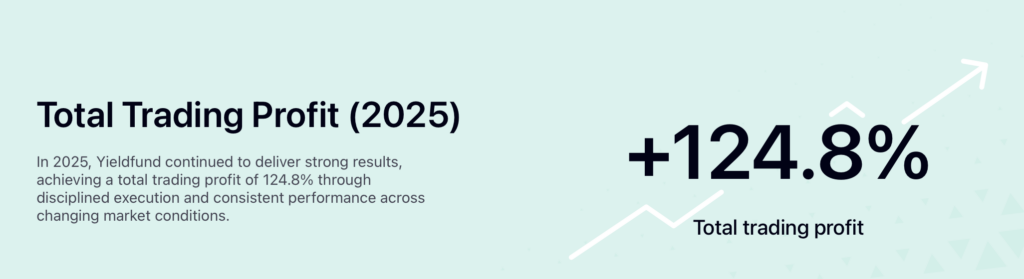
Investors can choose from fixed annual plan returns that can add up to 48% over a three-year plan. The difference between yearly profits does not automatically mean something is missing. It means the investor is using a packaged investment structure rather than running the trading strategy personally.
What are investors actually buying when they invest in Yieldfund
Investors in Yieldfund are buying access to a structured investment plan, not a seat on the trading desk. Yieldfund offers fixed-interest investment plans with weekly payouts and full capital return at the end of the term.
The difference in approach changes how investors evaluate Yieldfund. The question then becomes: what are the plan terms, how are payouts made, and how long are the plans for?
It also changes how potential investors compare crypto investments. A more relevant comparison is how investors access the crypto market without having to trade or bear the volatility. This shifts the approach from focusing on raw trading profits to embracing stable, predictable payouts.
Key difference that potential investors need to understand
The key difference is simple: trading profit is the result of Yieldfund’s trading activity, while investor profit is the return promised through Yieldfund’s investment plan. Those two numbers are related, yet not designed to be identical.
That distinction helps remove a lot of unnecessary confusion. Investors are not expected to analyze every market position because the product is built around a plan-based return model with weekly payouts and a fixed term.
FAQ
Is trading profit the same as what I earn as a Yieldfund investor?
No, trading profit is not the same as investor profit at Yieldfund. Trading profit refers to the results of the company’s trading strategy, while investor profit refers to the fixed return paid through the selected investment plan.
Does Yieldfund pay investors based on every trade?
No, Yieldfund does not present its model as trade-by-trade pass-through investing. Its website describes fixed-interest plans with weekly USDC payouts and end-of-term capital repayment.
Why can Yieldfund’s trading profit be higher than investor profits?
Yieldfund’s trading profit can be higher because internal trading performance and investor plan returns are different metrics. The company publishes trading performance separately from the fixed annual returns shown for its 1-year, 2-year, and 3-year plans.
About the authors

Written by
Vlad Hategan
SEO content writer
Writes the articles in the Yieldfund knowledge base.
Dutch, English, Romanian

Translated by
Patricia Van den Kerckhove
Senior content translator
Translates and reviews Yieldfund's content in Dutch.
Dutch (NL & BE), French, English