Global geopolitical risk: Market impacts

5 min

Global markets are currently navigating a complex maze of escalating conflicts, aggressive trade policies, and volatile commodity prices. Even for experienced investors, who manage risk assets – they’re currently behaving unpredictably.

Recent conflict escalations and strikes on critical energy infrastructures in the Middle East didn’t have only a local impact. Instead, it sent shockwaves through global supply chains, shifting global policies and politics to minimize the effects oil transit disruptions have on global markets.

These dual pressure points of oil shortage and ongoing tariffs issued by the United States are fundamentally altering global trade dynamics. It’s forcing central banks to rethink monetary policy timelines, which is delaying global growth.

The current climate is volatile, unpredictable and is not showing signs of slowing down.

Precious metals falter under monetary shifts

Conventional investment strategy has a safe haven investment during times of war and global uncertainty. Gold, until now as a safe-haven asset for many, but its market behavior recently has flipped the strategy entirely.

Prior to 2026, gold experienced its biggest moves, surpassing $5,400 at the end of 2025. As geopolitical tensions rose, gold recorded its seventh-straight loss, dropping to $4,588. Silver took an even harder hit, falling to $70 from a recent high of around $120. Instead of surging on fear, these precious metals plummeted to one-month lows.

Even though the conflict in the Middle East is impacting other commodities like oil, tensions are pricing inflation and pricing out interest rate cuts. Higher oil prices act as an indirect inflation accelerant and as a result, the US Federal Reserve opts to maintain rates steady.
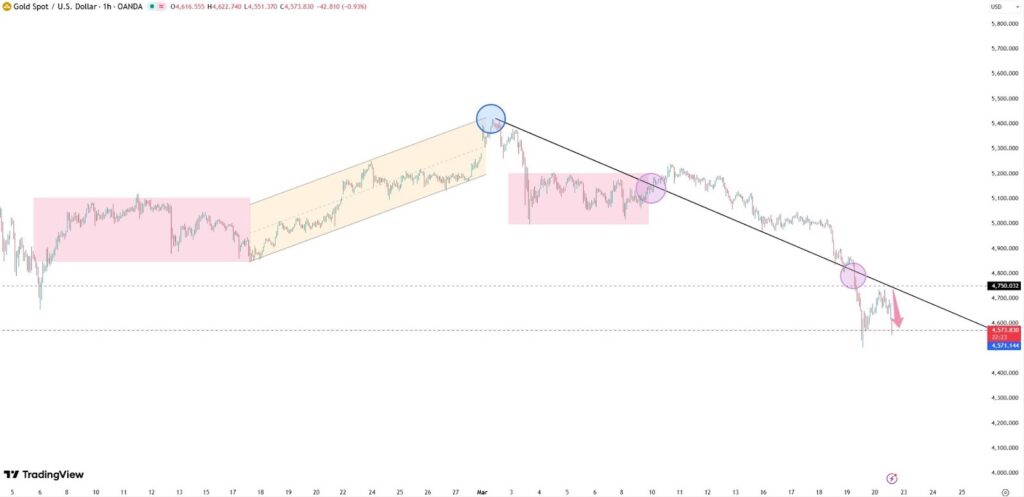
Essentially, markets have significantly reduced the probability of near-term interest rate cuts. Gold’s value is influenced by the opportunity cost of holding a zero-yield asset. With interest rates expected to remain higher for an extended period, that opportunity cost has increased substantially.

Energy infrastructure under threat

The Middle East crisis has escalated into a direct threat against global energy supplies. Military actions mark the first time that upstream fossil fuel production facilities have been explicitly targeted by both sides of the conflict. A drone attack on the Shah Gasfield forced the suspension of operations at this site which produces 1.28 billion standard cubic feet of gas a day, supplying 20% of the UAE’s gas and 5% of the world’s granulated sulfur.

Another escalation occurred on the Iranian South Pars production facility for the world’s largest gas field. This site is the backbone of Iran’s domestic energy grid and resulted in renewed hits on Qatar’s Ras Laffan, causing damage to Qatar’s premier liquefied natural gas (LNG) hub which is the global LNG producer.

As a result of the hits, gas prices in the EU have increased by 35%, and what’s more, the US has initiated partial suspension talks with Russia to remove sanctions and keep gas prices low.

Even so, the attacks have severe long-term consequences. Repairing complex energy infrastructure takes significant time and capital. The immediate market reaction saw Brent crude jump as high as $119 a barrel before settling near $104.

The EU economic reshaping

Without even knowing it, the EU has entered another energy crisis. With 20% of oil unable to pass through the Strait of Hormuz, energy and gas prices in the EU continued to increase. A potential positive outcome is the potential for the EU to continue to accelerate green energy adoption and become independent of oil supply.

Since the war started, markets have reacted swiftly. While major oil producers aren’t seeing stock prices increase, European indices are experiencing a slowdown. The STOXX 600 closed 2.39% down while Germany’s DAX lost 2.82%.

Financial systems are also reacting across the globe. As the Fed kept the rates unchanged for the next months, the BoE maintained its 3.75% interest rate, potentially increasing inflation concerns on the continent.

The US dollar has emerged as the clearest safe-haven winner, outperforming the Swiss franc and Japanese yen, but its immense strength threatens to choke out global trade and weigh heavily on corporate earnings.

Regional market impacts: US, Asia, and the EU

Geopolitical instability does not impact every region equally. Capital flows and economic policies are diverging across major global markets.

United States

The US economy is currently characterized by a remarkably strong dollar and tightening financial conditions. High interest rates are dampening domestic demand, while reciprocal tariffs threaten to spark trade wars. The strength of the dollar makes US exports less competitive globally, which could chip away at corporate profit margins over the coming quarters.

Asia

Asia remains the long-term engine for global growth, accounting for about 52% of worldwide electricity demand. Natural gas is the centerpiece of the region’s energy transition. Gas demand in the Asian power sector is projected to rise 32%, reaching 368 billion cubic meters (Bcm) by 2035. However, disruptions in the Middle East pose a direct threat to this trajectory.

European Union

The European Union faces a precarious balancing act. The 35% spike in European gas prices highlights the continent’s vulnerability to supply shocks. Simultaneously, the EU must navigate complex tariff negotiations with the US to protect its automotive and agricultural exports.

Securing capital in volatile times

The current geopolitical landscape is undeniably severe. Traditional safe havens are failing to perform, energy markets are under physical threat, and inflation is proving difficult to tame. For investors, relying on outdated strategies is no longer sufficient.

Quantitative trading platforms like Yieldfund provide European investors with a way to generate up to 48% yearly returns with weekly payouts. With volatility becoming more prominent, Yieldfund allows users to access the crypto market without having to trade themselves.

Want to understand how it works? Book a meeting with one of our investor relations managers and explore Yieldfund’s investment plans.


Related Articles

Cookies

Cookie statement for yieldfund.com

At yieldfund.com, we use cookies to improve the user experience, make our website function properly, and to display personalized content and ads. In this cookie statement, we explain what cookies we use, why we use them, and how you can manage your cookie preferences.

What are cookies?

Cookies are small text files that are stored on your device when you visit a website. These files allow the website to recognize your device during your visit and future visits. Cookies may be necessary for the website to function or may serve to personalize or improve the website.

Types of cookies we use

1. Necessary cookies
These cookies are essential for the proper functioning of the website. Without these cookies, certain parts of the website may not work properly. Necessary cookies do not collect information that can identify you.

Cookie NameProviderPersistentDurationPurpose
cf_bmhsforms.comYes0 hrSecures the website against bots and malicious traffic
_cfuvidhsforms.comNoTracks user session to optimize website performance
cf_bmhubspot.comYes0 hrWebsite protection against malicious traffic
_cfuvidhubspot.comNoSessionTracks user sessions to optimize website performance

2. Functional cookies
Functional cookies allow the website to remember user settings, such as language or login information.

Cookie NameProviderPersistentDurationPurpose
cf_bmhsforms.comYes0 hrWebsite security against bots and malicious traffic

3. Analytical cookies
Analytical cookies help us measure and improve website performance. These cookies collect anonymized data about how visitors use our website, such as the number of visitors and which pages are visited.

Cookie NameProviderPersistentDurationPurpose
hstchubspot.comYes1 yearTracks visitor behavior for website performance analysis
hssrchubspot.comNoSessionHelps determine whether the user revisits the website

4. Advertisement cookies
Advertising cookies are used to show relevant ads to you based on your browsing habits. These cookies may share information with advertising partners to show targeted ads.

Cookie NameProviderPersistentDurationPurpose
_fbpfacebook.comYes3 monthsOffers targeted ads on Facebook
_gaGoogle tag managerYes2 yearsSend data of users from devices and behavior for example to Google Analytics

How does consent work at Yieldfund?

First visit:

When you visit our website for the first time, a cookie popup will appear. Here, you can set your preferences:

  • You can accept all cookies.
  • You can selectively provide consent for specific categories of cookies (e.g., analytical or marketing cookies).

Adjusting Consent:

If you wish to modify your cookie preferences, this can be done easily:

  • At the bottom left of our website, you will find a notification button that allows you to reopen the cookie settings.
  • Through this button, you can adjust or withdraw your preferences at any time.

What are the implications of your choice?

Adjusting or refusing cookies does not affect the essential cookies required for our website to function properly. For other categories of cookies, you can easily specify what you accept or decline.
With this approach, we provide transparency and control over your cookie preferences.

For more information on how we process personal data, please refer to our Privacy Policy.

Privacy Policy

Privacy Statement of Yieldfund

Version: October 2024


Yieldfund is a trade name. The parent company of Yieldfund is Frontpay Capital B.V. For clarity, this privacy statement uses the name ‘Yieldfund,’ which also refers to Frontpay Capital B.V. This statement was originally drafted in Dutch, but versions in other languages may be available. In case of discrepancies, the Dutch version prevails.

1. Introduction

Yieldfund operates an online platform for financial services. This platform is accessible via our website: yieldfund.com and will be referred to as our “services.”

This is our Privacy Statement, explaining the types of personal data we collect and process through our services. Personal data includes all information that can directly or indirectly identify a person, as defined under the General Data Protection Regulation (GDPR). This statement also outlines our role in processing personal data, how long we retain such data, and your rights as a data subject.

We kindly ask you to read this Privacy Statement carefully. For further questions about the processing of your personal data, please contact us using the details at the end of this statement.

2. Who is responsible for processing your personal data?

Yieldfund is responsible for processing your personal data, as described in this Privacy Statement, and acts as the ‘data controller’ within the meaning of the GDPR.

For questions about processing your personal data, please contact us using the details provided at the end of this statement.

3. What personal data is processed, and where does it come from?

Yieldfund may process your personal data if you:

  • Visit or use our website or services;
  • Are a (authorized representative) client of ours;
  • Have a business relationship with Yieldfund;
  • Work at one of our service providers or other parties we collaborate with.

Special and/or sensitive personal data we process:

Our website and/or services do not intend to collect data about visitors younger than 16 years of age, unless they have parental or guardian consent. However, we cannot verify a visitor’s age. We recommend parents monitor their children’s online activities to prevent the collection of data without parental consent. If you believe we have collected personal data of a minor without consent, please contact us at info@yieldfund.com, and we will delete the information.

3.1 Information we collect automatically

When you visit our website or use our services, we automatically collect certain information, such as:

  • Usage data: including your IP address, the pages you visit, links clicked, and technical information (e.g., browser and system details). See our Cookie Statement for more details.
  • Data about your activities on our website.

3.2 Automated decision-making

Yieldfund makes decisions based on automated processes that may have significant effects on individuals.

These decisions are made by computer programs or systems without human involvement (e.g., a Yieldfund employee). Yieldfund uses the following programs or systems:

  • Sumsub: A compliance technology platform specializing in automating identity verification (IDV) and Know Your Customer (KYC) processes.

3.3 Information you provide to us

To use our services, we may request certain information, such as:

  • Registration details: Full name, address, date and place of birth, gender, phone number, country, and email address.
  • Identification details: A copy of your passport, driver’s license, or ID card, including a selfie for verification purposes.
  • Financial information: Your bank account number (if applicable), transaction details, and wallet address.
  • Other information: Source of income.

3.4 Information generated by us or received from third parties

To use our services, we may request certain information, such as:

  • Risk and fraud reports: Based on your transactions and behavior on our platform.
  • Third-party data: We may receive information from external sources such as public databases or blockchain analysis providers.

3.5 Use by third parties

Third parties include:

  • Marketing partner: HubSpot;
  • Cloud service provider: Rootnet;
  • Identity verification platform: Sumsub;
  • Communication provider: Bird.com.

Yieldfund may share data with suppliers, audit bodies, government authorities, and companies or individuals hired by Yieldfund to perform specific tasks (including processors).

Data may also be shared with third parties to support the provision of our services.

Yieldfund may provide data to third parties if required by applicable laws, court orders, or other legal obligations or with the data subject’s explicit consent.

4. For what purposes do we process your personal data?

We process your personal data for the following purposes:

  • To comply with legal obligations, such as anti-money laundering laws.
  • To deliver and improve our services.
  • To prevent fraud and abuse.
  • To communicate with you about your account and our services.
  • For marketing purposes, depending on your preferences.
  • To provide customer service.
  • For research and development to optimize our services.

5. Data retention periods

We do not retain your personal data longer than necessary for the purposes for which it was collected unless we are legally obligated to retain it longer.

Retention criteria:

  • Agreements: Data is retained for the duration of the agreement.
  • Legal obligations: Data is retained as long as legally required.
  • Legitimate interests: Data is retained as long as necessary to protect such interests.

If Yieldfund has asked for and received your (explicit) consent to process your personal data, Yieldfund will retain it until you withdraw that (explicit) consent or it is deemed to have expired without your renewed (explicit) consent.

Legal retention periods:

  • Tax purposes: 7 years after the relevant calendar year (Art. 52, Dutch General Tax Act).
  • Anti-Money Laundering and Terrorist Financing Act (Wwft): 5 years after the business relationship ends (Art. 33).
  • Wwft reporting requirements: 5 years after notification to the FIU (Art. 34).

6. Your rights

Under the GDPR, you have certain rights regarding your personal data, including the right to access, correct, delete, and restrict processing. You can exercise these rights at any time by contacting us.

7. Changes

Yieldfund reserves the right to amend this privacy statement. We recommend reviewing this statement regularly for updates.

8. Right to lodge a complaint

Yieldfund handles personal data with care and aims for continuous improvement. If you have tips or complaints about our handling of personal data, please contact Yieldfund’s Data Protection Officer. You may also file a complaint with the Dutch Data Protection Authority.

9. Security

Yieldfund has implemented appropriate technical and organizational measures to protect personal data against loss or unlawful use. If data is processed by third parties on behalf of Yieldfund, a data processing agreement ensures that data is handled securely and adequately.

International data transfer:

Personal data may be transferred outside the European Economic Area (EEA) to countries deemed to provide an adequate level of data protection under GDPR. This includes Canada (commercial organizations), Japan, Switzerland, and New Zealand. For transfers outside these countries, standard contractual clauses will apply.

10. Contact information

For questions, comments, or complaints about this Privacy Statement or the processing of your personal data, please contact us at:

  • Email: info@yieldfund.com
  • Post: Hanzeweg 5, 7418 AW, Deventer, Attn: Yieldfund Data Protection Officer

Sign up for our online Webinar

You will discover how investing through Yieldfund works and get the chance to ask all your questions in person.