

The 4 main types of stablecoins investors should know

7 min

The four main types of stablecoins are fiat-backed, crypto-backed, commodity-backed, and algorithmic. These digital assets maintain a stable value by being pegged to the value of a collateral. This provides a secure way for investors to manage crypto market volatility and interact with DeFi products – and much more.

For European investors looking to diversify their portfolios and protect capital, understanding how these digital currencies operate is critical.

What are stablecoins

Stablecoins are cryptocurrencies that hold a consistent value and are pegged to $1. They use reference assets to back up the value of $1 with most stables tracking USD. Other collaterals can be used to issue a stablecoin including commodities or cryptocurrencies.

Stablecoins mirror the value of a USD to make trading crypto easier during periods of volatility. It also makes it possible for traders to avoid having to consistently convert assets into BTC and make the trading experience more familiar to traditional investing.

Why stablecoins exist

Stablecoins exist to provide a safe haven at times for crypto investors. During periods of volatility or when traders want to exit positions, stablecoins are among the only cryptocurrencies which don’t experience volatility, with the value pegged to $1.

Investors have become integrated into the crypto and then the global financial network to make transferring tokens easier and globally. Stablecoins are transparent and depending on the network used, transactions can take seconds to complete.

Why stablecoins differ from fiat and digital payments

Traditional digital payments rely on third parties to verify and approve transactions while stablecoins are executed automatically on the blockchain. Stablecoins are transparent and the value of a transaction is recorded in real time and can be cross-referenced on the network.

Another difference is that digital payments can only be processed during business hours, while stablecoins are operational 24/7 making them easier to use globally, without too many gatekeepers.

Traditional digital payments represent electronic claims on bank deposits within local financial systems. Stablecoins represent programmable, globally accessible digital bearer instruments.

For example, cross-border wire transfers can take up to seven days to clear and require multiple routings. Stablecoin transfers move peer-to-peer instantly on networks like Ethereum or Solana.

What are the different types of stablecoins available today
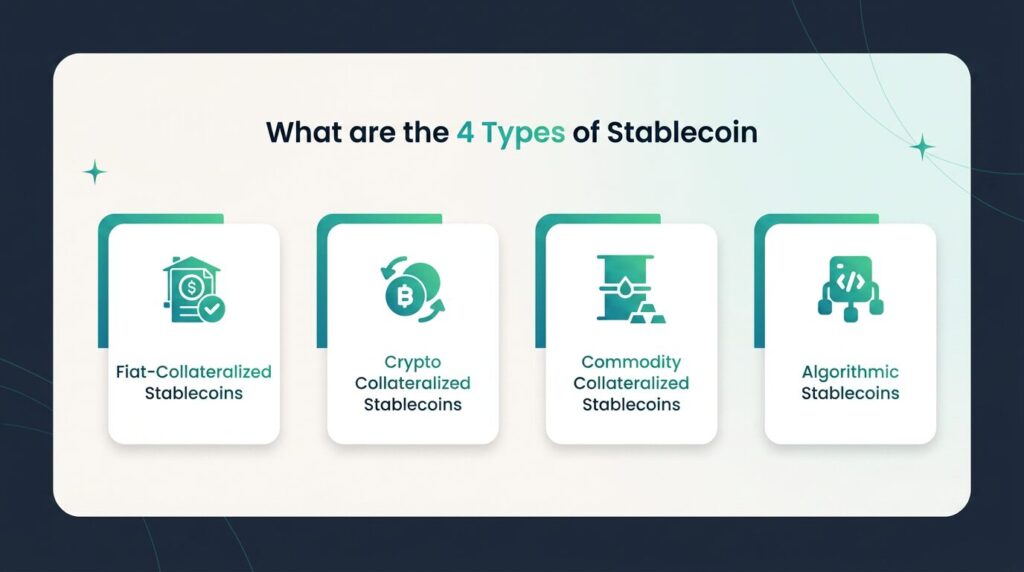
Fiat-backed stablecoins

Fiat-backed stablecoins are backed one-to-one by traditional currencies and highly liquid equivalents held in off-chain reserves. This means the issuing company holds actual dollars, euros, or short-term government securities in a regulated bank account to match every token in circulation.

Because of this direct backing, regulators heavily favor fiat-backed models, and they dominate overall stablecoin activity. Major examples include USDC and USDT.

Crypto-backed stablecoins

Crypto-backed stablecoins use other volatile cryptocurrencies as collateral to maintain their value. To account for market volatility, these systems are over-collateralized via automated smart contracts.

Thus if someone wants to mint $1 of crypto-backed stablecoins like DAI, they need to deposit $2 worth of cryptocurrencies. In the DAI example, issuers need to deposit $2 worth of Ethereum in order to account for the volatility. This buffer protects the peg even if the underlying cryptocurrency experiences a sharp price drop.

Commodity-backed stablecoins

Commodity-backed stablecoins represent digital ownership of physical assets like gold or silver. Each token acts as a direct claim on a specific amount of the underlying commodity held in a secure vault. For instance, PAX Gold (PAXG) and Tether Gold (XAUT) allow investors to gain exposure to gold prices without the logistical burdens of storing physical metal.

Algorithmic stablecoins

Algorithmic stablecoins use computer code to automatically manage token supply and demand without relying on underlying reserves. The algorithm mints new tokens when the price goes above the peg target and burns tokens when the price drops below it.

As they lack tangible collateral, algorithmic stablecoins carry a high risk of systemic failure. The 2022 collapse of the algorithmic stablecoin TerraUSD (UST) erased billions in value, proving that these models struggle to maintain stability under extreme market stress.

How different types of stablecoins stay stable

Stablecoins keep their price pegged through collateralization as one of the main approaches. Other types of stablecoins such as crypto or algorithmic can rely on smart contract automation and market arbitrage to retain their value.

Fiat-backed stablecoins keep the equivalent value of USD or other fiat currencies in their treasury. This means 1 stablecoin can be exchanged with $1 at any time at a fixed one-to-one rate. The arbitrage method means, if the price of a stablecoin like USDC is depegged and drops to $0.98, arbitrage automation buys discounted tokens and exchanges them with the issuer at $1.00 per token.

Crypto and algorithmic models rely on smart contracts to automatically rebalance the pools. In this scenario, any attempted manipulation triggers the smart contract to either purchase or sell assets to maintain the peg. While it requires enough liquidity to keep afloat, the system is the most prone to vulnerabilities.

What is the difference between the two types of stablecoins: USDC and USDT

USDC and USDT are one of the main types of stablecoins which are widely used across crypto and TradFi. They are both backed by fiat, however some also hold bonds and other assets in their reserves. Transparency is what impacts institutional adoption for both types of stablecoins.

USDT (Tether)

USDT is issued by Tether Limited and is the largest stablecoin by circulation, processing hundreds of billions of dollars per month. Its reserves are backed by a mixture of USD, secured loans, precious metals, and other investments. Tether provides quarterly reserve breakdowns but has historically faced regulatory scrutiny regarding its reserve disclosures.

USDC (USD Coin)

USDC is issued by Circle. The asset is heavily utilized in decentralized finance and corporate treasury operations. Its reserves are backed exclusively by cash and short-term US Treasury bonds, offering a high degree of transparency. Circle provides daily reserve attestations and uses top-tier regulated custodians like BNY Mellon, making USDC highly more trusted across institutional investors.

Stablecoins usage in companies and day-to-day transactions

Companies increasingly use stablecoins for real-time merchant settlement, corporate treasury management, and cross-border business-to-business payments. Stablecoin infrastructure allows businesses to bypass the delays and high fees associated with legacy correspondent banking.

In corporate treasuries, stablecoins enable 24/7 liquidity management. Firms can move capital instantly across geographies to fund operations or execute high-yield investment strategies. Payment service providers integrate stablecoins to offer merchants instant payout capabilities with zero chargeback risk. Between January 2023 and August 2025, over $136 billion in stablecoin payments were settled, demonstrating massive institutional confidence in this technology.

Which stablecoin options are best for use in the Netherlands

For investors operating in the Netherlands, fiat-backed stablecoins that comply with the European Union’s Markets in Crypto-Assets (MiCA) regulation are the safest and most efficient options. The Netherlands has established itself as a major hub for innovative trading companies in Europe’s financial markets.

Under MiCA rules implemented in late 2024, stablecoin issuers must fully back their tokens with real money, segregate funds, and provide clear redemption rights. Euro-pegged tokens like EURI, issued by Banking Circle, are specifically designed to meet these stringent European standards.

Secure your portfolio with stable investments

Stablecoins provide an important bridge between TradFi and the cryptocurrency market. As the market matures and is expected to grow to over $300 billion in the next five years, it’s important to understand which ones to be integrated with.

If you still want to explore the crypto market without the stress of daily market management and stablecoin juggling, Yieldfund, a quantitative trading company from the Netherlands, provides access to crypto yields without hands-on trading. Investors can get up to 4% weekly returns paid out directly in stablecoins.

Contact one of our investor relations managers to learn more about Yieldfund.

Related Articles

Cookies

Cookie statement for yieldfund.com

At yieldfund.com, we use cookies to improve the user experience, make our website function properly, and to display personalized content and ads. In this cookie statement, we explain what cookies we use, why we use them, and how you can manage your cookie preferences.

What are cookies?

Cookies are small text files that are stored on your device when you visit a website. These files allow the website to recognize your device during your visit and future visits. Cookies may be necessary for the website to function or may serve to personalize or improve the website.

Types of cookies we use

1. Necessary cookies
These cookies are essential for the proper functioning of the website. Without these cookies, certain parts of the website may not work properly. Necessary cookies do not collect information that can identify you.

Cookie NameProviderPersistentDurationPurpose
cf_bmhsforms.comYes0 hrSecures the website against bots and malicious traffic
_cfuvidhsforms.comNoTracks user session to optimize website performance
cf_bmhubspot.comYes0 hrWebsite protection against malicious traffic
_cfuvidhubspot.comNoSessionTracks user sessions to optimize website performance

2. Functional cookies
Functional cookies allow the website to remember user settings, such as language or login information.

Cookie NameProviderPersistentDurationPurpose
cf_bmhsforms.comYes0 hrWebsite security against bots and malicious traffic

3. Analytical cookies
Analytical cookies help us measure and improve website performance. These cookies collect anonymized data about how visitors use our website, such as the number of visitors and which pages are visited.

Cookie NameProviderPersistentDurationPurpose
hstchubspot.comYes1 yearTracks visitor behavior for website performance analysis
hssrchubspot.comNoSessionHelps determine whether the user revisits the website

4. Advertisement cookies
Advertising cookies are used to show relevant ads to you based on your browsing habits. These cookies may share information with advertising partners to show targeted ads.

Cookie NameProviderPersistentDurationPurpose
_fbpfacebook.comYes3 monthsOffers targeted ads on Facebook
_gaGoogle tag managerYes2 yearsSend data of users from devices and behavior for example to Google Analytics

How does consent work at Yieldfund?

First visit:

When you visit our website for the first time, a cookie popup will appear. Here, you can set your preferences:

  • You can accept all cookies.
  • You can selectively provide consent for specific categories of cookies (e.g., analytical or marketing cookies).

Adjusting Consent:

If you wish to modify your cookie preferences, this can be done easily:

  • At the bottom left of our website, you will find a notification button that allows you to reopen the cookie settings.
  • Through this button, you can adjust or withdraw your preferences at any time.

What are the implications of your choice?

Adjusting or refusing cookies does not affect the essential cookies required for our website to function properly. For other categories of cookies, you can easily specify what you accept or decline.
With this approach, we provide transparency and control over your cookie preferences.

For more information on how we process personal data, please refer to our Privacy Policy.

Privacy Policy

Privacy Statement of Yieldfund

Version: October 2024


Yieldfund is a trade name. The parent company of Yieldfund is Frontpay Capital B.V. For clarity, this privacy statement uses the name ‘Yieldfund,’ which also refers to Frontpay Capital B.V. This statement was originally drafted in Dutch, but versions in other languages may be available. In case of discrepancies, the Dutch version prevails.

1. Introduction

Yieldfund operates an online platform for financial services. This platform is accessible via our website: yieldfund.com and will be referred to as our “services.”

This is our Privacy Statement, explaining the types of personal data we collect and process through our services. Personal data includes all information that can directly or indirectly identify a person, as defined under the General Data Protection Regulation (GDPR). This statement also outlines our role in processing personal data, how long we retain such data, and your rights as a data subject.

We kindly ask you to read this Privacy Statement carefully. For further questions about the processing of your personal data, please contact us using the details at the end of this statement.

2. Who is responsible for processing your personal data?

Yieldfund is responsible for processing your personal data, as described in this Privacy Statement, and acts as the ‘data controller’ within the meaning of the GDPR.

For questions about processing your personal data, please contact us using the details provided at the end of this statement.

3. What personal data is processed, and where does it come from?

Yieldfund may process your personal data if you:

  • Visit or use our website or services;
  • Are a (authorized representative) client of ours;
  • Have a business relationship with Yieldfund;
  • Work at one of our service providers or other parties we collaborate with.

Special and/or sensitive personal data we process:

Our website and/or services do not intend to collect data about visitors younger than 16 years of age, unless they have parental or guardian consent. However, we cannot verify a visitor’s age. We recommend parents monitor their children’s online activities to prevent the collection of data without parental consent. If you believe we have collected personal data of a minor without consent, please contact us at info@yieldfund.com, and we will delete the information.

3.1 Information we collect automatically

When you visit our website or use our services, we automatically collect certain information, such as:

  • Usage data: including your IP address, the pages you visit, links clicked, and technical information (e.g., browser and system details). See our Cookie Statement for more details.
  • Data about your activities on our website.

3.2 Automated decision-making

Yieldfund makes decisions based on automated processes that may have significant effects on individuals.

These decisions are made by computer programs or systems without human involvement (e.g., a Yieldfund employee). Yieldfund uses the following programs or systems:

  • Sumsub: A compliance technology platform specializing in automating identity verification (IDV) and Know Your Customer (KYC) processes.

3.3 Information you provide to us

To use our services, we may request certain information, such as:

  • Registration details: Full name, address, date and place of birth, gender, phone number, country, and email address.
  • Identification details: A copy of your passport, driver’s license, or ID card, including a selfie for verification purposes.
  • Financial information: Your bank account number (if applicable), transaction details, and wallet address.
  • Other information: Source of income.

3.4 Information generated by us or received from third parties

To use our services, we may request certain information, such as:

  • Risk and fraud reports: Based on your transactions and behavior on our platform.
  • Third-party data: We may receive information from external sources such as public databases or blockchain analysis providers.

3.5 Use by third parties

Third parties include:

  • Marketing partner: HubSpot;
  • Cloud service provider: Rootnet;
  • Identity verification platform: Sumsub;
  • Communication provider: Bird.com.

Yieldfund may share data with suppliers, audit bodies, government authorities, and companies or individuals hired by Yieldfund to perform specific tasks (including processors).

Data may also be shared with third parties to support the provision of our services.

Yieldfund may provide data to third parties if required by applicable laws, court orders, or other legal obligations or with the data subject’s explicit consent.

4. For what purposes do we process your personal data?

We process your personal data for the following purposes:

  • To comply with legal obligations, such as anti-money laundering laws.
  • To deliver and improve our services.
  • To prevent fraud and abuse.
  • To communicate with you about your account and our services.
  • For marketing purposes, depending on your preferences.
  • To provide customer service.
  • For research and development to optimize our services.

5. Data retention periods

We do not retain your personal data longer than necessary for the purposes for which it was collected unless we are legally obligated to retain it longer.

Retention criteria:

  • Agreements: Data is retained for the duration of the agreement.
  • Legal obligations: Data is retained as long as legally required.
  • Legitimate interests: Data is retained as long as necessary to protect such interests.

If Yieldfund has asked for and received your (explicit) consent to process your personal data, Yieldfund will retain it until you withdraw that (explicit) consent or it is deemed to have expired without your renewed (explicit) consent.

Legal retention periods:

  • Tax purposes: 7 years after the relevant calendar year (Art. 52, Dutch General Tax Act).
  • Anti-Money Laundering and Terrorist Financing Act (Wwft): 5 years after the business relationship ends (Art. 33).
  • Wwft reporting requirements: 5 years after notification to the FIU (Art. 34).

6. Your rights

Under the GDPR, you have certain rights regarding your personal data, including the right to access, correct, delete, and restrict processing. You can exercise these rights at any time by contacting us.

7. Changes

Yieldfund reserves the right to amend this privacy statement. We recommend reviewing this statement regularly for updates.

8. Right to lodge a complaint

Yieldfund handles personal data with care and aims for continuous improvement. If you have tips or complaints about our handling of personal data, please contact Yieldfund’s Data Protection Officer. You may also file a complaint with the Dutch Data Protection Authority.

9. Security

Yieldfund has implemented appropriate technical and organizational measures to protect personal data against loss or unlawful use. If data is processed by third parties on behalf of Yieldfund, a data processing agreement ensures that data is handled securely and adequately.

International data transfer:

Personal data may be transferred outside the European Economic Area (EEA) to countries deemed to provide an adequate level of data protection under GDPR. This includes Canada (commercial organizations), Japan, Switzerland, and New Zealand. For transfers outside these countries, standard contractual clauses will apply.

10. Contact information

For questions, comments, or complaints about this Privacy Statement or the processing of your personal data, please contact us at:

  • Email: info@yieldfund.com
  • Post: Hanzeweg 5, 7418 AW, Deventer, Attn: Yieldfund Data Protection Officer

Sign up for our online Webinar

You will discover how investing through Yieldfund works and get the chance to ask all your questions in person.