


Investing in crypto is one of the more attractive alternative strategies to diversify and get exposure to a new asset class. With more Dutch investors looking for how to increase their exposure, this guide explores crypto investment funds and companies in the Netherlands.
What are crypto investment funds
Crypto investment funds or firms are companies that have managed investment structures and allow others to participate in the process. Each investment fund differs from the others, and they stand out through higher capital allocation and expertise.
Investment funds offer ease of use. Instead of investors having to manage their wallets, execute trades, and worry about volatility, they allocate capital to a crypto fund and let it handle the strategy and execution.
The structure of the funds can vary, and from our experience, they operate as traditional asset managers. Some companies build a long-term portfolio, while others provide consistent returns that are above market averages. There are also funds that use arbitrage systems and algorithmic strategies to access the market.
In the Netherlands, the investment landscape consists of a mix of managed crypto providers, quantitative trading companies, wealth firms, and venture capital firms.
What do crypto investment funds do
A crypto investment fund or company exists to make it easier for investors to get exposure to the crypto markets. They have more capital and experience in the industry, which makes the offer and service more attractive for retail.
Globally, data shows that crypto funds have over $132 million in AUM. By comparison, total Bitcoin ETFs hold between $107 - $109 billion in assets under management, with a large portion attributed to BlackRock. With numbers showing increasing demand, each fund has different strategies to generate returns for its investors.
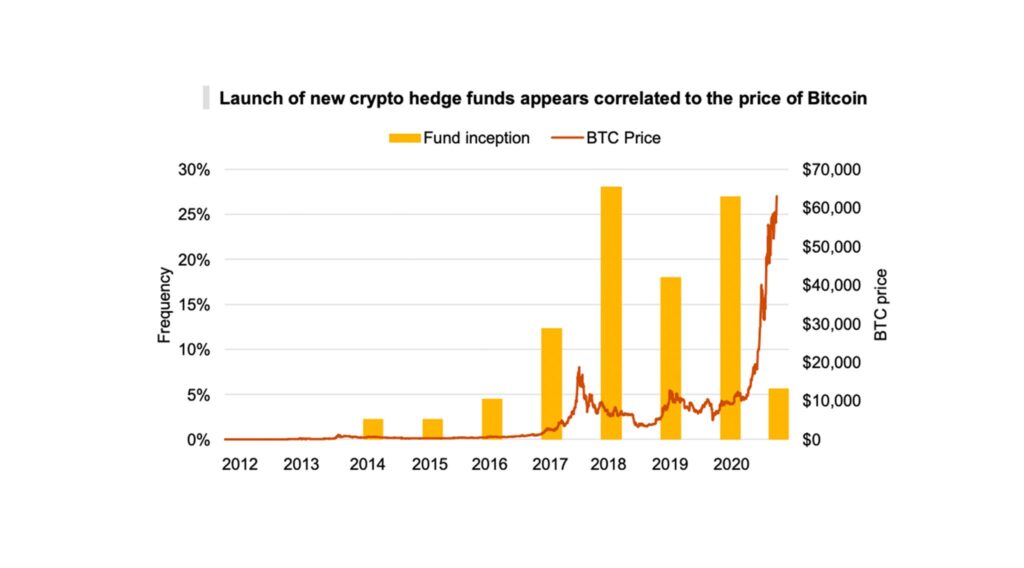
Funds trade and give investors access to the crypto market. The way they do it varies, with some companies using algorithmic trading, others using research and long-term buy-and-hold strategies, while others rely on volatility and automation to leverage price inefficiencies.
The exact role of the company depends on its strategy. There's no good or bad strategy, but they are attractive to investors because they remove friction points and steep learning curves—such as volatility, industry insights, and profits.
What to Look for When Investing in a Crypto Fund
Each crypto investment company has its own rules and ways of assessing its efforts. The more important features in a fund that investors are interested in are: minimum investment, security, and payouts.
Before investing, it is important to understand how the company operates, how returns are generated, and what level of risk is involved.
Minimum investment
Minimum investments vary across the Dutch market. Traditionally, investment companies, even in TradFi or crypto, are targeting high-net-worth individuals due to their strategies—large capital with low yields and low risk.
Thus, the minimum investment indicates the type of service that's offered. However, private investment structures have larger ticket sizes starting from €100,000, with some outliers like Yieldfund starting from €10,000.
Security
Security is one of the more important considerations investors need to make. Crypto markets operate in a technical environment. This means investors need to understand how custody is set, how their capital is stored, and what security is in place to prevent fraudulent activity.
Communication is then a big part of the security protocol, which also overlaps with regulations—like the AFM in the Netherlands.
Payout structure
Crypto investment companies generate returns in different ways, which means payout structures can vary substantially.
Some firms focus purely on long-term portfolio appreciation without regular payouts. Others distribute returns weekly or monthly, depending on the structure of the investment product.
It is also important to understand whether projected returns are fixed, variable, performance-based, or dependent on broader market conditions.
6 crypto investment funds and companies in the Netherlands
| Yieldfund | Quantitative crypto trading | €10,000 | Automated quantitative trading | Weekly payouts | Passive & retail investors |
| Amdax | Crypto asset management | Varies | Managed crypto portfolios | Portfolio-based growth | Wealth management clients |
| Coinmerce Capital | Managed crypto investing | Varies | Diversified crypto investing | Portfolio appreciation | Retail and private investors |
| Mercury Redstone | Crypto venture capital | Institutional/private | Blockchain startup investments | Long-term equity exposure | Venture-focused investors |
| Maven 11 | Crypto venture capital | Institutional/private | Early-stage Web3 investments | Fund-based returns | Institutional investors |
| HODL | Crypto broker/platform | Low entry barrier | Crypto buying and holding | Market appreciation | Beginner crypto investors |
Yieldfund
Yieldfund is a Dutch quantitative trading company that trades the top 10 cryptocurrencies on the market. It relies on algorithmic trading strategies and provides investors with up to 48% yearly returns depending on their plan.
The company is structured to pay out yields under a bond contract. Investors can opt for a 1, 2, or 3-year plan with yearly interest of 24%, 36%, and 48%. The company also has a lower entry barrier of €10,000, making it more accessible to regular investors without requiring high capital allocation. The goal is to create a systematic approach to crypto exposure while removing the need for investors to actively trade markets themselves.
Returns are always paid weekly on Yieldfund, and at the end of the selected term, the original invested capital is repaid according to the structure of the investment plan.
Amdax
Amdax is a regulated crypto investment company that has positioned itself as one of the Netherlands’ best-known crypto wealth management companies.
Amdax provides a suite of digital services, including custody, trading, and portfolio management. As an investment company, AMDAX has a different starting structure with a €100,000 minimum investment. It also requires investors to pay a startup fee of €950 and a 1.6% fee yearly for all AUM.
The company is regulated under AFM and is expected to be among the few Dutch crypto companies to receive the European MiCAR license. Additionally, the company is positioned as a long-term portfolio management company rather than an investment fund.
Coinmerce Capital
Coinmerce Capital is a traditional crypto investment fund and among the largest in the Netherlands. The fund has generated average returns from crypto of up to 40% per year since 2018 and is registered with the AFM.
It's an alternative to traditional investment funds and provides two types of investment strategies with yearly returns of 15% or 35%, depending on the risk level. The payment structure is similar to others in the market: €100,000 minimum investment and a 2% management fee for investors.
The Coinmerce ecosystem gives its investment arm visibility among retail investors already familiar with cryptocurrency platforms in the Netherlands.
Mercury Redstone
Mercury Redstone is a crypto investing index and investing firm that invests in early Web3 startups and infrastructure to generate profits. The company uses Bitvavo and Knaken to allow them to have an indexed crypto portfolio. Investors can access Mercury Redstone with a lower investment of €2,500, which is significantly lower than market competitors.
The difference, however, lies in the risk level. Mercury's investment risk is often tied to startup growth and broader adoption of blockchain technologies. Thus, payouts aren't guaranteed, and returns depend on the index's market performance.
Maven 11
Maven 11 has become one of the most recognized crypto-native investment funds. The company has grown within the Netherlands as well as in the EU, with minimal investment capital, in the Netherlands and the wider European blockchain ecosystem.
The company is not a retail yield platform and does not offer fixed returns or regular payouts. Instead, Maven 11 backs crypto founders and protocols over a multi-year investment horizon. According to its 2019 Key Information Document, Maven 11 Capital BV was registered with the AFM under the AIFMD “light” regime, meaning it was registered as an exempted manager but not subject to full AFM or DNB license supervision.
Maven 11 has a minimum investment of €100,000 and a 4.0% management fee, alongside other ongoing and performance-related costs, with investment strategies centered on future growth potentials.
HODL.nl
HODL is a Dutch crypto fund manager that offers professionally managed crypto investment strategies for professional investors. Its products are closer to traditional investment funds than simple crypto brokerage services, with strategies that may include actively managed portfolios, algorithmic trading, DeFi-related services, and venture capital exposure.
The Hodl Oracle Fund is registered with the AFM under registration number 50026692, although that specific fund is currently closed to new investors. Investment funds are only targeted at professional investors, with a minimum investment starting from €100,000.
HODL does not present fixed or guaranteed returns, and available fund documentation for the Oracle Fund lists a 0.5% quarterly management fee and a 20% performance fee on positive returns.
How are crypto investment funds regulated in the Netherlands?
In the Netherlands, crypto funds that provide interest and returns to investors fall into multiple groups. The AFM is the governmental body responsible for regulating and overseeing financial services. It supervises parts of the crypto industry, and depending on the service offered and the returns, companies can either be registered or simply notified with the Dutch Authority for the Financial Markets (AFM).
It's worth understanding that regulatory obligations can differ substantially between crypto brokers, asset managers, custodians, trading companies, and venture investment firms.
Accessing your first crypto investment fund
Crypto investments can be risky. Retail traders with less experience in the industry are more likely to benefit from crypto funds or companies to build wealth and even get exposure to the market.
With market options providing different types of ownership, it's important to understand how companies operate, what the risks are, what the payouts are, and, more importantly, what the known and unknown costs are.
For investors who prefer a passive approach with a low entry barrier, Yieldfund provides structured returns with up to 48% yearly returns and weekly payouts depending on the chosen investment plan.