
How compounding interest in finance works for everyday investors

8 min

Compounding interest is how wealth is built effectively since it lets invested capital snowball into more capital that grows faster the longer someone lets it stay invested. In finance and investing, it’s one of the ways to accumulate wealth without dividends.

  • Compounding interest means earning returns on the main invested amount as well as the accumulated returns.
  • Wealth builds over time, and investing earlier can add more to a retirement balance than starting later.
  • Fees and taxes are hidden expenses retail investors fail to account for when calculating their expected total returns.

What is compounding interest in finance?

Compounding interest is the interest people earn on the initial investment but also on the returns they received from their investment. Explained simply, it’s the interest someone earns on their existing earned interest.

Compounding works since any interest that is generated by an investment is added back into the main principal. This makes the total invested capital higher, and earning the same interest on a higher investment yields higher interest per year or month.

With compound interest, the invested balance grows at an accelerating rate because each period’s earnings are added to the base that generates the next period’s earnings.

Consider a €5,000 investment earning 10% annually. In year one, you earn €500, bringing your balance to €5,500. In year two, you earn 10% not just on the original €5,000 but also on that €500. Putting it in perspective, a €5,000 investment can grow to approximately €100,000 in 30 years.

How compounding works for everyday investors

Compounding works when investment returns are added back into the investment account rather than withdrawn. Every euro or dollar you reinvest gets added to the main invested account, which grows the total invested capital and indirectly the returns for the next month.

When you invest in the stock market, ETFs, or crypto, you don’t earn a fixed interest rate. In our experience, the returns which are generated are the result of the changing value of your investments. In some cases, the stock market also pays out dividends.

For retail investors, when those returns stay invested rather than withdrawn, that’s when compounding takes place. On quantitative trading companies like Yieldfund, investment plans pay out weekly. Investors don’t add the money back into the plan, so they are not compounding their wins.

Why focus on compounding vs. simple interest?

Compound interest matters more than simple interest because the gap between them widens dramatically over time. Early on, the difference is small. Over decades, it becomes enormous.

Using an example of a starting balance of a €6,000 balance at a 3.5% rate, here’s how both interest types stand out:

Time periodSimple interest balanceCompound interest balance
Year 1€6,210€6,210
Year 10€8,100€8,464
Year 30~€12,300~€16,840

After 30 years of investing, compounding interest adds more capital to someone’s balance. Based on the calculation, it adds another €4,500 on the same starting balance without extra effort. When people look to invest for retirement, compounding interest is more recommended because capital is stacking and you don’t lose interest opportunities.

When comparing investment options, look beyond the headline rate. An account that compounds will always outperform one that pays simple interest at the same rate, or that pays dividents.

How is compounding ROI calculated?

Calculating compounding interest takes into consideration the main investment (the principal), the rate of return or percentage increase, and how frequently those returns are reinvested.

From our view, understanding how often your interest is added back into the principal means you’re able to earn a lot more from your investments. For example, when returns are added every year, your investment is losing opportunities to earn more. Weekly or monthly contributions might not seem like a big difference, but they make up for higher returns over a longer period.

For a quick estimate, you can use the Rule of 72. This simple trick helps you approximate how long it will take for your investment to double. Just divide 72 by your annual rate of return. The S&P 500 has historically provided up to 8% returns.

Strategies to maximize compounding interest

To maximize the effects of compounding, there are a few things that can be done by any type of investor. That’s because they create a pattern and a foundation for compounding capital to grow faster and have a bigger impact on the total capital. These strategies include:

Investing early

The most valuable fuel for a compounding strategy is time, because it allows for interest to add up and grow the principal amount. One year’s difference isn’t creating such a big difference, but starting 5 or 10 years earlier can add thousands more.

The upside is that investing early means a lower investment can grow to the same amount as someone who invests €100,000. Investing €6,000 per year at 7% until the age of retirement can have different outcomes. Someone who starts at 25 retires with approximately €1.5 million, while someone who starts at 30 ends up with €1 million. That’s €500,000 less despite investing only €30,000 less.

Invest often

Regular contributions feed the compounding engine and can reduce risk. Steady investing and DCAing through both market highs and lows means you buy the same amount at the same time regardless if it’s higher or lower.

This not only helps keep investing structured, but it helps retail investors remove emotions from trading. Investing often and having weekly or monthly compounding creates faster ways to grow an investment portfolio.

How is compounding calculated in finance?

Compounding interest is calculated by applying the return rate to a balance that includes all previously earned returns, repeated over each compounding period. The more frequently it compounds, the faster the balance grows. The compounding frequency varies by product: savings and money market accounts typically compound daily, while certificates of deposit (CDs) compound daily or monthly.

Bonds compound semi-annually, loans often compound monthly, and credit cards compound daily, which is why card debt grows so quickly. For building wealth through compounding, the idea is to have a higher number of compounding periods which translate to greater compounding interest.

Why isn’t every investment compounding?

Not every investment is compounding automatically, because some are paid out rather than reinvested. For example, most company stocks pay out dividends to their investors and if they are not added back as a stock, they won’t yield higher returns.

There is a difference between compounding and non-compounding investments and the reasons depend on the type of investment you’re choosing. Some investment tools like ETFs have dividends and accumulation. Dividends are paid out yearly based on the fund’s performance, while accumulation is accumulating/compounding the returns.

Reinvestment is central to building wealth. The key difference between compounding and non-compounding investments lies in how returns are handled. When earnings are withdrawn from the investment, they can no longer generate further growth, so for an investment to compound, earnings must be reinvested, either automatically or manually.

How fees and taxes affect your net compounding interest profits

Although compounding can significantly increase an investor’s wealth, the often-cited 7% average annual return from the S&P 500 isn’t what investors actually keep. Capital gains taxes, levied when an investment is sold, can reduce this final amount.

While fees and taxes may seem like a small percentage, they compound against you over time. Every euro paid in fees or taxes is a euro that no longer earns future returns.

Consider an investment with a 7% annual return. A fund charging just a 1% annual fee could reduce your final balance by roughly a quarter over 30 years. For example, a portfolio that should have grown to €761,000 would instead be closer to €574,000, with more than a 15% loss.
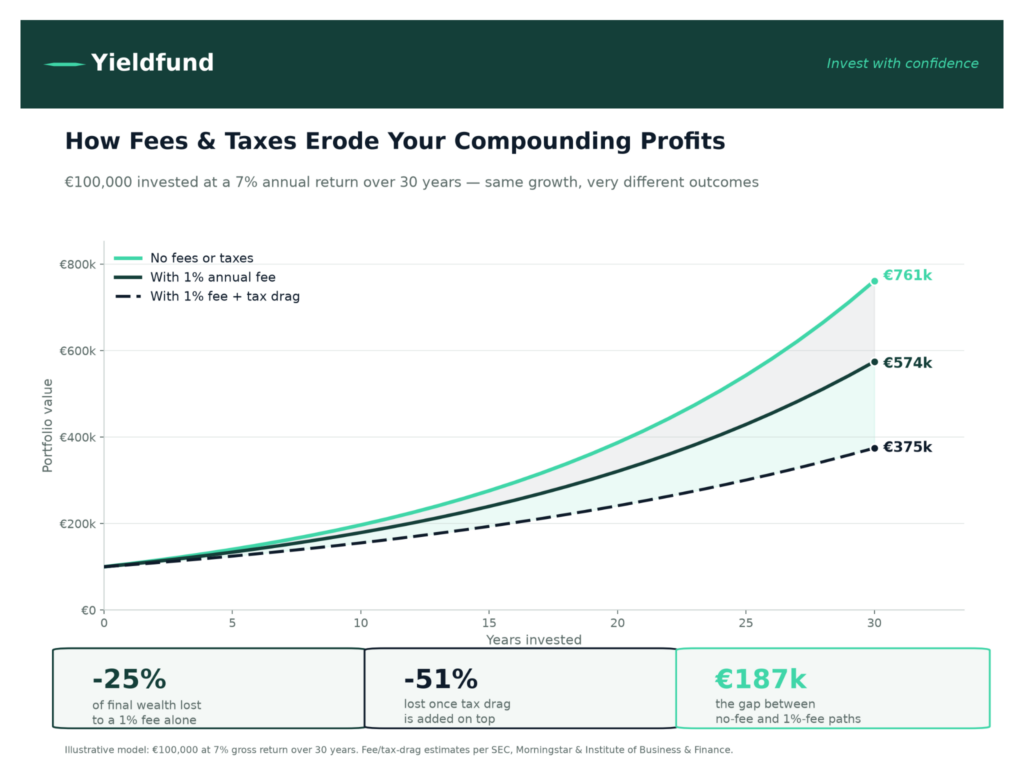
Taxes have a similar effect. Paying tax on gains annually in a regular account, rather than letting them compound untouched, can reduce your final wealth by 25–40% over several decades. Fortunately, this is one part of compounding you can control.

By choosing low-cost index funds and using tax-advantaged accounts where returns grow uninterrupted, you can ensure the math of compounding works for you, not against you.

Final words

For investors, compounding interest rewards is about creating a structured plan and acting on it early. Investing regularly, starting as early as possible even with a lower budget, has the potential to turn modest contributions into substantial portfolio wealth over time.

A first step for retail investors is to know how compounding is calculated, what returns to look for, and weigh them against unknown future fees. Accumulating stocks adds compounding without extra work, while other financial instruments like quantitative trading companies such as Yieldfund pay out weekly, and the payouts have to be reinvested to compound.

Frequently asked questions

What is compound interest in simple terms?

Compound interest means earning returns on both your original money and the returns it has already earned.

How long does it take compound interest to make a real difference?

Compounding works gradually, with the biggest gains starting to appear over 10 or 15 years.

Does compounding frequency really matter?

Yes, the more often interest compounds, the faster your balance grows since reinvesting money every one year compared to every month makes a significant difference.

What’s the difference between compound interest and compound returns?

Compound interest applies to savings accounts, bonds, and loans. Compound returns is a broader concept that includes dividends and capital gains from stocks, mutual funds, and other investments.


Related Articles

Cookies

Cookie statement for yieldfund.com

At yieldfund.com, we use cookies to improve the user experience, make our website function properly, and to display personalized content and ads. In this cookie statement, we explain what cookies we use, why we use them, and how you can manage your cookie preferences.

What are cookies?

Cookies are small text files that are stored on your device when you visit a website. These files allow the website to recognize your device during your visit and future visits. Cookies may be necessary for the website to function or may serve to personalize or improve the website.

Types of cookies we use

1. Necessary cookies
These cookies are essential for the proper functioning of the website. Without these cookies, certain parts of the website may not work properly. Necessary cookies do not collect information that can identify you.

Cookie NameProviderPersistentDurationPurpose
cf_bmhsforms.comYes0 hrSecures the website against bots and malicious traffic
_cfuvidhsforms.comNoTracks user session to optimize website performance
cf_bmhubspot.comYes0 hrWebsite protection against malicious traffic
_cfuvidhubspot.comNoSessionTracks user sessions to optimize website performance

2. Functional cookies
Functional cookies allow the website to remember user settings, such as language or login information.

Cookie NameProviderPersistentDurationPurpose
cf_bmhsforms.comYes0 hrWebsite security against bots and malicious traffic

3. Analytical cookies
Analytical cookies help us measure and improve website performance. These cookies collect anonymized data about how visitors use our website, such as the number of visitors and which pages are visited.

Cookie NameProviderPersistentDurationPurpose
hstchubspot.comYes1 yearTracks visitor behavior for website performance analysis
hssrchubspot.comNoSessionHelps determine whether the user revisits the website

4. Advertisement cookies
Advertising cookies are used to show relevant ads to you based on your browsing habits. These cookies may share information with advertising partners to show targeted ads.

Cookie NameProviderPersistentDurationPurpose
_fbpfacebook.comYes3 monthsOffers targeted ads on Facebook
_gaGoogle tag managerYes2 yearsSend data of users from devices and behavior for example to Google Analytics

How does consent work at Yieldfund?

First visit:

When you visit our website for the first time, a cookie popup will appear. Here, you can set your preferences:

  • You can accept all cookies.
  • You can selectively provide consent for specific categories of cookies (e.g., analytical or marketing cookies).

Adjusting Consent:

If you wish to modify your cookie preferences, this can be done easily:

  • At the bottom left of our website, you will find a notification button that allows you to reopen the cookie settings.
  • Through this button, you can adjust or withdraw your preferences at any time.

What are the implications of your choice?

Adjusting or refusing cookies does not affect the essential cookies required for our website to function properly. For other categories of cookies, you can easily specify what you accept or decline.
With this approach, we provide transparency and control over your cookie preferences.

For more information on how we process personal data, please refer to our Privacy Policy.

Privacy Policy

Privacy Statement of Yieldfund

Version: October 2024


Yieldfund is a trade name. The parent company of Yieldfund is Frontpay Capital B.V. For clarity, this privacy statement uses the name ‘Yieldfund,’ which also refers to Frontpay Capital B.V. This statement was originally drafted in Dutch, but versions in other languages may be available. In case of discrepancies, the Dutch version prevails.

1. Introduction

Yieldfund operates an online platform for financial services. This platform is accessible via our website: yieldfund.com and will be referred to as our “services.”

This is our Privacy Statement, explaining the types of personal data we collect and process through our services. Personal data includes all information that can directly or indirectly identify a person, as defined under the General Data Protection Regulation (GDPR). This statement also outlines our role in processing personal data, how long we retain such data, and your rights as a data subject.

We kindly ask you to read this Privacy Statement carefully. For further questions about the processing of your personal data, please contact us using the details at the end of this statement.

2. Who is responsible for processing your personal data?

Yieldfund is responsible for processing your personal data, as described in this Privacy Statement, and acts as the ‘data controller’ within the meaning of the GDPR.

For questions about processing your personal data, please contact us using the details provided at the end of this statement.

3. What personal data is processed, and where does it come from?

Yieldfund may process your personal data if you:

  • Visit or use our website or services;
  • Are a (authorized representative) client of ours;
  • Have a business relationship with Yieldfund;
  • Work at one of our service providers or other parties we collaborate with.

Special and/or sensitive personal data we process:

Our website and/or services do not intend to collect data about visitors younger than 16 years of age, unless they have parental or guardian consent. However, we cannot verify a visitor’s age. We recommend parents monitor their children’s online activities to prevent the collection of data without parental consent. If you believe we have collected personal data of a minor without consent, please contact us at info@yieldfund.com, and we will delete the information.

3.1 Information we collect automatically

When you visit our website or use our services, we automatically collect certain information, such as:

  • Usage data: including your IP address, the pages you visit, links clicked, and technical information (e.g., browser and system details). See our Cookie Statement for more details.
  • Data about your activities on our website.

3.2 Automated decision-making

Yieldfund makes decisions based on automated processes that may have significant effects on individuals.

These decisions are made by computer programs or systems without human involvement (e.g., a Yieldfund employee). Yieldfund uses the following programs or systems:

  • Sumsub: A compliance technology platform specializing in automating identity verification (IDV) and Know Your Customer (KYC) processes.

3.3 Information you provide to us

To use our services, we may request certain information, such as:

  • Registration details: Full name, address, date and place of birth, gender, phone number, country, and email address.
  • Identification details: A copy of your passport, driver’s license, or ID card, including a selfie for verification purposes.
  • Financial information: Your bank account number (if applicable), transaction details, and wallet address.
  • Other information: Source of income.

3.4 Information generated by us or received from third parties

To use our services, we may request certain information, such as:

  • Risk and fraud reports: Based on your transactions and behavior on our platform.
  • Third-party data: We may receive information from external sources such as public databases or blockchain analysis providers.

3.5 Use by third parties

Third parties include:

  • Marketing partner: HubSpot;
  • Cloud service provider: Rootnet;
  • Identity verification platform: Sumsub;
  • Communication provider: Bird.com.

Yieldfund may share data with suppliers, audit bodies, government authorities, and companies or individuals hired by Yieldfund to perform specific tasks (including processors).

Data may also be shared with third parties to support the provision of our services.

Yieldfund may provide data to third parties if required by applicable laws, court orders, or other legal obligations or with the data subject’s explicit consent.

4. For what purposes do we process your personal data?

We process your personal data for the following purposes:

  • To comply with legal obligations, such as anti-money laundering laws.
  • To deliver and improve our services.
  • To prevent fraud and abuse.
  • To communicate with you about your account and our services.
  • For marketing purposes, depending on your preferences.
  • To provide customer service.
  • For research and development to optimize our services.

5. Data retention periods

We do not retain your personal data longer than necessary for the purposes for which it was collected unless we are legally obligated to retain it longer.

Retention criteria:

  • Agreements: Data is retained for the duration of the agreement.
  • Legal obligations: Data is retained as long as legally required.
  • Legitimate interests: Data is retained as long as necessary to protect such interests.

If Yieldfund has asked for and received your (explicit) consent to process your personal data, Yieldfund will retain it until you withdraw that (explicit) consent or it is deemed to have expired without your renewed (explicit) consent.

Legal retention periods:

  • Tax purposes: 7 years after the relevant calendar year (Art. 52, Dutch General Tax Act).
  • Anti-Money Laundering and Terrorist Financing Act (Wwft): 5 years after the business relationship ends (Art. 33).
  • Wwft reporting requirements: 5 years after notification to the FIU (Art. 34).

6. Your rights

Under the GDPR, you have certain rights regarding your personal data, including the right to access, correct, delete, and restrict processing. You can exercise these rights at any time by contacting us.

7. Changes

Yieldfund reserves the right to amend this privacy statement. We recommend reviewing this statement regularly for updates.

8. Right to lodge a complaint

Yieldfund handles personal data with care and aims for continuous improvement. If you have tips or complaints about our handling of personal data, please contact Yieldfund’s Data Protection Officer. You may also file a complaint with the Dutch Data Protection Authority.

9. Security

Yieldfund has implemented appropriate technical and organizational measures to protect personal data against loss or unlawful use. If data is processed by third parties on behalf of Yieldfund, a data processing agreement ensures that data is handled securely and adequately.

International data transfer:

Personal data may be transferred outside the European Economic Area (EEA) to countries deemed to provide an adequate level of data protection under GDPR. This includes Canada (commercial organizations), Japan, Switzerland, and New Zealand. For transfers outside these countries, standard contractual clauses will apply.

10. Contact information

For questions, comments, or complaints about this Privacy Statement or the processing of your personal data, please contact us at:

  • Email: info@yieldfund.com
  • Post: Hanzeweg 5, 7418 AW, Deventer, Attn: Yieldfund Data Protection Officer