
Yieldfund was built for Bitcoin volatility, where retail investors often lose discipline. Crypto markets move through sharp repricings, leverage flushes, ETF reversals, and option-market stress. Most retail investors want crypto exposure, not daily trading—they can’t keep up with the complexity.
This week proved the point: Bitcoin fell below $63,000 on 4 June 2026, its lowest level since February, down over 14% in a week and 21% in four weeks. Such moves can shake investor confidence. For Yieldfund, volatility is the core market condition.
Bitcoin volatility is back in focus
The latest Bitcoin selloff was more than a simple pullback. On June 3rd, BTC has already fallen by 9.5% in seven days, returning to the range it traded in between February and April. A day later, the selloff deepened below $63,000.
Bitcoin had traded above $71,000 earlier in the week before dipping below the mid-$60,000s. That created a familiar crypto pattern: weaker prices, forced liquidation, reduced buying demand, and ETF investors pulling capital.
This is why Bitcoin volatility deserves attention even when the long-term thesis remains intact. The market can reprice risk in days, not quarters. Investors who only look at yearly return charts miss the pressure points that determine whether they can actually stay invested.
How volatility hurts traders
For retail traders, volatility is a period of high uncertainty. When portfolios are red, the normal response is to sell to protect what’s left, but traders often view volatility as a timing problem. They buy after a rally, add leverage when momentum looks strongest, and then face margin calls when the market reverses.
The June sell-off, which rapidly slid below major support levels, is a clear sign of how that can happen. CoinGlass data shows that approximately $1.84 billion in leverage positions were liquidated in 24 hours on 3 June. It serves as the largest wipeout since 5 February. Long positions took about $1.66bn of the damage, while shorts accounted for only $180m.
The trader can be right about long-term adoption and still be wrong about position size, entry timing, or leverage. Volatility punishes weak risk management before it rewards conviction, and that’s precisely where retail traders fit.
Why volatility also creates opportunity
Volatility provides more than just risk signals; it also adds structure signals. When prices move quickly, spreads widen, liquidity shifts, correlations change, and forced flows create temporary dislocations.
Data shows how the BTC and ETH 30-day implied volatility indices posted their largest single-day gains since the 5 February crash. Another report notes that Bitcoin’s BVIV implied volatility jumped nearly 20% to 46.45% on 3 June, after two calmer months.
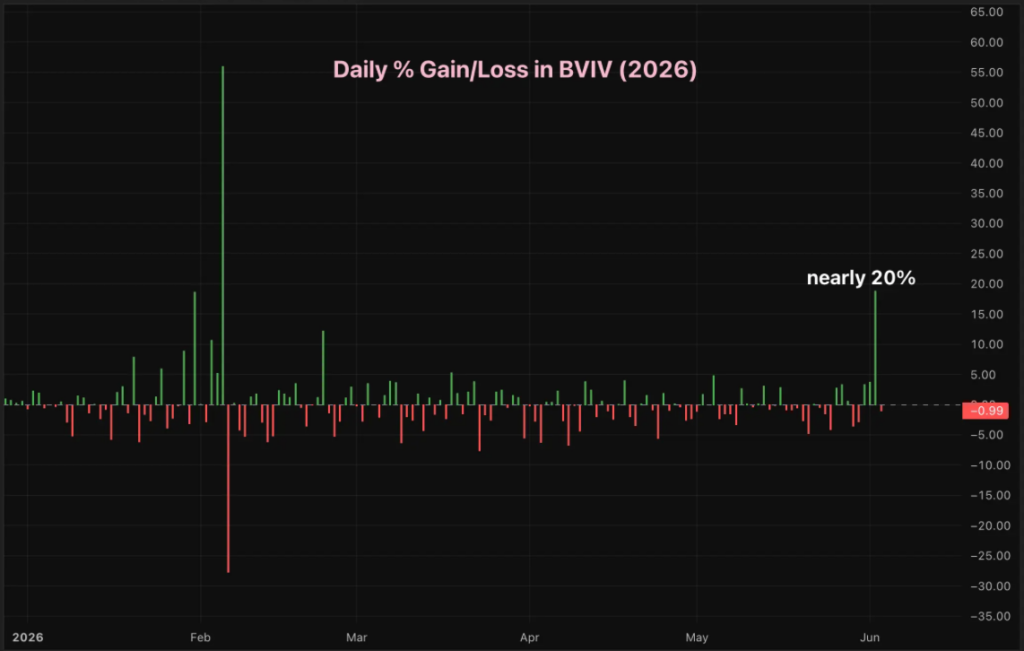
The bigger 2026 panic came in February, when Bitcoin’s 30-day implied volatility surged from just over 40 to 95 as BTC fell toward $60,000. The lesson is not that every volatility spike is the same. It is that 2026 has already produced multiple windows where the market’s expected range changed violently.
What ETF flows say about investor sentiment
ETF flows are significant to Bitcoin’s volatility because they quickly reflect changes in institutional investor sentiment. Spot Bitcoin ETFs have deepened institutional participation, making flows capable of amplifying major market shifts. When ETF demand rises, it supports price momentum. Conversely, outflows can withdraw a key source of demand, leading to increased price fluctuations and heightened volatility.
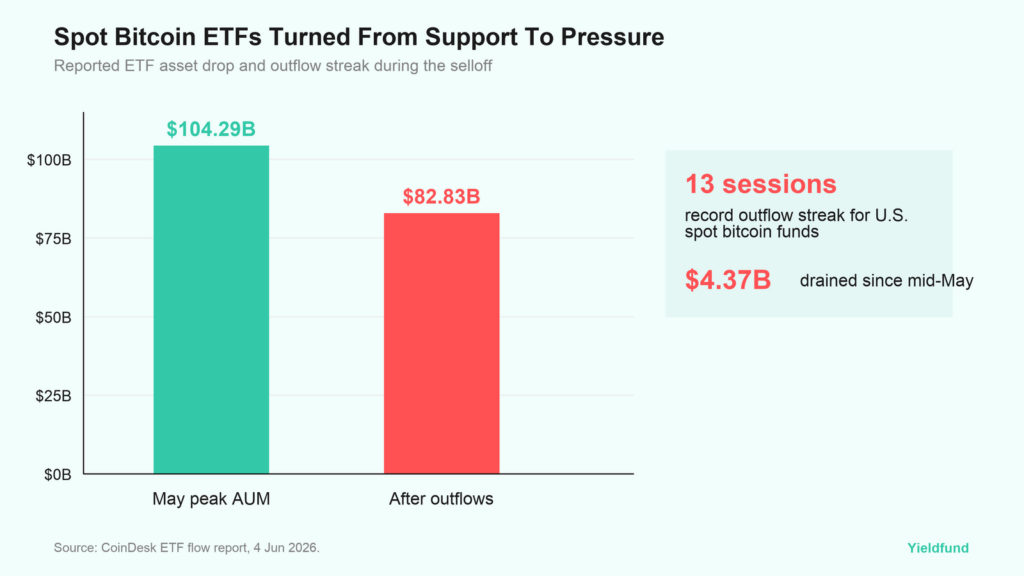
U.S. spot Bitcoin ETFs saw 13 straight sessions of outflows by 4 June, with $4.37bn drained since mid-May. Assets dropped from $104.29bn to $82.83bn over the same period. ETF flows can support Bitcoin in calm markets, but they can also become a source of pressure when risk appetite turns.
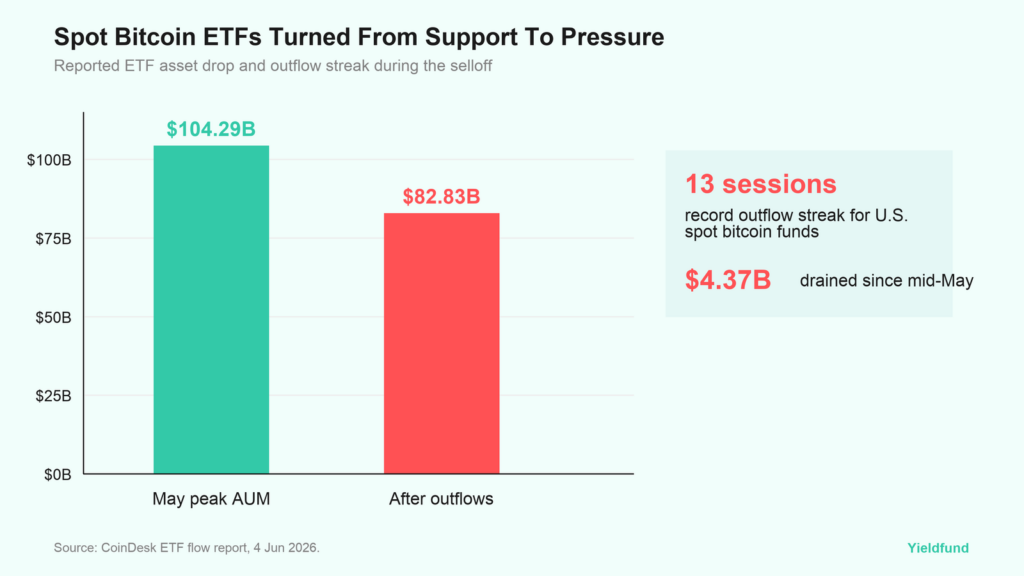
The shift in ETF flows that contributed to the recent selloff illustrates their influence on volatility. When ETF investors pull out funds, it can accelerate price swings rather than stabilize the market. If outflows persist, Bitcoin’s main demand channels from 2024 to 2026 may help sustain higher volatility, even if long-term investor interest remains.
What Investors should understand about Bitcoin now
Bitcoin volatility is not automatically good. It can create opportunity, but it can also destroy capital. A 14% weekly drawdown, a $1.84bn liquidation cascade, and a 13-session streak of ETF outflows are not small events. They are evidence that crypto remains one of the most aggressive liquid markets in the world.
The signal for investors is not “Bitcoin is broken.” It is that Bitcoin still trades like a high-beta liquidity asset. It can rally powerfully when capital is flowing in, and risk appetite is high, then reprice violently when leverage unwinds, or ETF demand weakens.
Is Bitcoin’s volatility a sign of more to come? The data says investors should prepare for that possibility. The combination of price drawdowns, liquidation pressure, implied-volatility spikes, and ETF outflows points to a market where risk is being repriced quickly. That can create opportunity, but only for investors who treat volatility as a condition to manage rather than a signal to chase.
For retail investors who don’t want to trade Bitcoin’s volatility, Yieldfund offers a way to access crypto yields without requiring users to trade themselves. Instead, they can participate in the yields generated by Yieldfund, through structured investment plans with yields of up to 48% per year and weekly payouts.
While it is still not a bank deposit or equivalent to holding spot Bitcoin, it reflects the broader point of this article: volatile markets require discipline more than prediction.