

Are we in a bear market in crypto? What the data says in 2026

9 min

The crypto market has entered a bear market at the end of 2025, as capital is rotating into other assets such as commodities or tech stocks. Bitcoin is in bear market territory because the reference token has traded below its 200-day moving average for over 230 days and is down more than 50% from its peak.

  • The 2025-2026 bear market currently lasts for 235 days as of June 26th.
  • A bear market in crypto is when the market is down more than 20% from the highs and sentiment is shifting.
  • A bear market can last between 1 to 2 years before market sentiment recovers and new investors access the market.
  • Bear markets recover after the four-year Bitcoin halving when there are fewer BTC assets and assets become scarce.

What is a bear market in crypto?

A bear market in crypto is when the entire sentiment about digital assets is changing, retail investors aren’t showing the same risk appetite, and the price of BTC has fallen by more than 20% since its all-time high. The difference between a bear market and a correction is that market downturns last longer and don’t recover in a week or two.

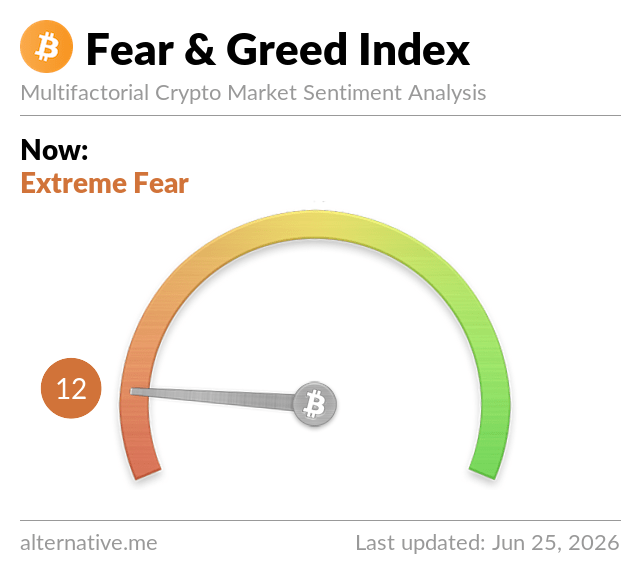
In longer time frames, the price of BTC and other crypto assets form lower lows, and investor sentiment is changing. The Crypto Fear & Greed Index is a good indicator of investor sentiment, which is currently at a level of 12 out of 100. In bull markets, the Fear & Greed Index is ranging around 90.
Why do traders call it a bear market?

Traders refer to the period as a bear market because it’s similar to how a bear attacks, swiping its paw in a downward motion. Similarly, the price of Bitcoin and other assets is experiencing swift declines as prices slide every day.

Contrary to what would be intuitive, bear markets don’t mean a period when investors are inert and fail to take action. As mentioned above, it refers to how prices move in the market rather than how investors behave in the period of uncertainty when prices are sliding lower and there’s no incentive to invest.

When was the last bear market in crypto?

The last bear market in crypto started in 2022 after the market peaked in 2021 at $67,617 and then dropped to $15,742 in November 2022. The drawdown was triggered by a black swan event, which refers to a perception-altering event with the Terra/LUNA ecosystem collapse in May 2022.

As in every situation, bear markets follow periods of euphoria when the market feels invincible. Following the LUNA event, other companies like FTX declared bankruptcy, which led to a lot of liquidity being taken out of the market. Data collected by CoinGecko notes the bear market lasted 381 days, with Bitcoin prices dropping by 76.7% in a year.

How bad was each bear market cycle?

Each crypto bear market has had a different duration and depth, but the structural ones have consistently wiped out 75% or more of Bitcoin’s value. The table below compares Bitcoin’s major bear cycles, using data that defines a bear market as any period where Bitcoin closes below its 200-day moving average for 30 or more consecutive days.

Bear MarketDuration (Days)Max DrawdownBottom PriceBottom Date
2014–2015321-81.6%$155Jan 14, 2015
2018–2019385-83.6%$3,217Dec 15, 2018
2019–202081-66.3%$6,627Dec 18, 2019
2020 COVID52-74.4%$5,033Mar 17, 2020
2021 Mid-Cycle80-52.9%$29,972Jul 21, 2021
2022–2023381-76.7%$15,742Nov 10, 2022
2025–2026 (Current)233+-51.2%$60,862Jun 7, 2026

The steepest Bitcoin bear markets by percentage drawdown were the 2018–2019 cycle, when Bitcoin collapsed 83.6% from its peak of ~$19,800 down to $3,217 (bottoming on December 15, 2018) over 385 days, and the 2014–2015 cycle, when Bitcoin lost 81.6% of its value, falling from ~$1,163 to a low of $155 across 321 days.

The 2022–2023 bear market came close, with a 76.7% drawdown that wiped Bitcoin from its all-time high of ~$69,000 down to $15,742 by November 10, 2022, a 381-day grind that destroyed more dollar-value than any prior cycle.

Shorter but equally violent, the 2020 COVID crash erased 74.4% of Bitcoin’s price in just 52 days, bottoming at $5,033 on March 17, 2020. The 2019–2020 correction (-66.3%) bottomed at $6,627 and the 2021 mid-cycle drop (-52.9%), which bottomed at $29,972, were comparatively milder and shorter-lived, resolving in under 90 days each.

The current 2025–2026 cycle has so far seen a -51.2% drawdown, with Bitcoin hitting a cycle low of $60,862 on June 7, 2026, making it the mildest bear market by percentage thus far.

How do bear markets in crypto differ from traditional finance?

A bear market in crypto is more severe than in traditional finance because crypto markets are more volatile and experience sharper drops even when correcting. One of the reasons is because stock markets have circuit breakers which halt trading during periods of volatility to prevent complete wipeouts. Bitcoin, on the other hand, has on several occasions and on specific exchanges dropped by 99.9%.

For comparison, pullbacks of 3-5% in the S&P 500 are rare and happen 2-3 times per year, while in crypto, they can happen in intraday trading hours. Another difference is how quickly markets recover. Bitcoin takes between 12-24 months to recover from lows, while the S&P 500 required 4 years to recover from the 2020 COVID crash and 13 years to recover from the dot-com bubble.

Crypto markets are heavily leveraged, so falling prices trigger cascading liquidations that accelerate declines. This also means that emotional trading plays a role in how traders behave, even though large-volume trades are mainly automated.

In sum, crypto markets have bigger downs more often but recover much faster. The S&P 500, as a point of reference, has had price corrections higher than 10% only 38 times since 1950 and recovered much slower than the crypto market.

How to identify a bear market in crypto

Bear markets are identified by drops from highs of more than 20% over a longer period of time, lower interest in crypto investments, and low on-chain activity. When looking at technical indicators on longer time frames, in bear markets, Bitcoin is trading below the 200-day moving average; in the current cycle, it is trading 230 days below it.

Another technical indicator that shows up in a bear market is the RSI, which shows the market is heavily oversold. This means any negative news on the market has a much stronger negative effect on the price. Investors and institutions are liquidating their positions to acquire Bitcoin much cheaper.

Accumulation phases on longer time frames of one year are signs crypto is in a bear market, as external shocks often confirm or intensify the trend.

Does a bear market last longer than a bull market?

Bear and bull markets operate differently, and since 2011, bear markets have been significantly shorter than bull markets. Bear cycles can last between 1 to 2 years depending on the duration and the length, while bull markets last more than two years. This, however, is conditional and depends on how traders perceive the time the bull market has started.

Bitcoin’s two longest bear cycles between 2018–2019 (385 days) and 2022–2023 (381 days) lasted close to a year. Traditional markets show the same pattern: the average S&P 500 bear market runs about 9.6 months, while the average bull market lasts roughly 2.7 years.

How to adapt your strategy to a crypto bear market

In bear markets, when crypto isn’t going only up, the strategy should focus on preserving capital and accumulating crypto at lower prices rather than chasing bigger wins. The strategy is then positioning the portfolio for the next bull market cycle without over-exposure.

Dollar-cost averaging (DCA) is a powerful strategy even in a bear market because it spreads the costs over a longer period, which covers price declines and price increases. Buying a fixed amount at the same time removes emotion and still keeps capital intact without overspending.

Sizing your positions to 2% to 5% of your portfolio per asset ensures significant drops won’t devastate your holdings. A way to approach this in a bear market is to have a set plan, add buy and sell orders, and also diversify capital into other investments that are in a bull market.

Diversifying strategies can include generating yield from stablecoins, which doesn’t add impermanent loss, and investors are also acquiring assets without trading. Another example is Yieldfund, where investors get a fixed return based on the chosen plan without having to trade. Yieldfund does the trading and investors receive weekly payouts with up to 4% monthly returns depending on the chosen plan. Combining one of the strategies positions investors to navigate the bear market in crypto structurally better.

Can you still make money and trade in a bear market?

Yes, you can still make money in a bear market, but it requires different strategies than buying dips in a bull run. Volatility stays high during downturns, which creates opportunities for prepared traders.

Several approaches can work when applied with strict risk management:

  • Short selling: Borrowing and selling an asset to buy it back lower. This profits directly from declines but carries unlimited theoretical risk, so stop-losses are essential.
  • Put options and inverse products: These rise in value as prices fall, with the downside capped at your invested capital.
  • Range trading: Buying near support and selling near resistance works well when prices move sideways.
  • Strategic accumulation: Building positions in quality assets at depressed prices to position for the next bull cycle.

The bottom line for investors

Crypto is in a bear market in 2026, but the data offers context that should steady nervous hands. The current cycle is the mildest major downturn on record so far, bear markets are shorter than the bull runs that follow, and every previous crypto bear market has ended in a new all-time high. Discipline beats prediction during periods like this.

Frequently asked questions

Can you protect capital during a bear market in crypto?

Yes, investors can protect capital by diversifying their portfolio, holding stablecoins, investing carefully, generating yield, and dollar-cost averaging (DCA). Moving part of your holdings into stablecoins to prevent further losses also generates opportunities for earning without trading.

Is a bear market or a bull market better?

Bull markets are better for growing portfolio value quickly, while bear markets offer the most attractive entry points for long-term investors.

How do you know the bear market will continue?

You can’t know for certain, but several signals suggest a bear market is ongoing rather than ending, which include the Bitcoin fear and greed index, more negative news, and low on-chain activity.

How are investors behaving during a bear market?

In bear markets, investors panic-sell as losses mount and negative headlines spread, while long-term holders and some institutions accumulate quality assets at lower prices.

Related Articles

Cookies

Cookie statement for yieldfund.com

At yieldfund.com, we use cookies to improve the user experience, make our website function properly, and to display personalized content and ads. In this cookie statement, we explain what cookies we use, why we use them, and how you can manage your cookie preferences.

What are cookies?

Cookies are small text files that are stored on your device when you visit a website. These files allow the website to recognize your device during your visit and future visits. Cookies may be necessary for the website to function or may serve to personalize or improve the website.

Types of cookies we use

1. Necessary cookies
These cookies are essential for the proper functioning of the website. Without these cookies, certain parts of the website may not work properly. Necessary cookies do not collect information that can identify you.

Cookie NameProviderPersistentDurationPurpose
cf_bmhsforms.comYes0 hrSecures the website against bots and malicious traffic
_cfuvidhsforms.comNoTracks user session to optimize website performance
cf_bmhubspot.comYes0 hrWebsite protection against malicious traffic
_cfuvidhubspot.comNoSessionTracks user sessions to optimize website performance

2. Functional cookies
Functional cookies allow the website to remember user settings, such as language or login information.

Cookie NameProviderPersistentDurationPurpose
cf_bmhsforms.comYes0 hrWebsite security against bots and malicious traffic

3. Analytical cookies
Analytical cookies help us measure and improve website performance. These cookies collect anonymized data about how visitors use our website, such as the number of visitors and which pages are visited.

Cookie NameProviderPersistentDurationPurpose
hstchubspot.comYes1 yearTracks visitor behavior for website performance analysis
hssrchubspot.comNoSessionHelps determine whether the user revisits the website

4. Advertisement cookies
Advertising cookies are used to show relevant ads to you based on your browsing habits. These cookies may share information with advertising partners to show targeted ads.

Cookie NameProviderPersistentDurationPurpose
_fbpfacebook.comYes3 monthsOffers targeted ads on Facebook
_gaGoogle tag managerYes2 yearsSend data of users from devices and behavior for example to Google Analytics

How does consent work at Yieldfund?

First visit:

When you visit our website for the first time, a cookie popup will appear. Here, you can set your preferences:

  • You can accept all cookies.
  • You can selectively provide consent for specific categories of cookies (e.g., analytical or marketing cookies).

Adjusting Consent:

If you wish to modify your cookie preferences, this can be done easily:

  • At the bottom left of our website, you will find a notification button that allows you to reopen the cookie settings.
  • Through this button, you can adjust or withdraw your preferences at any time.

What are the implications of your choice?

Adjusting or refusing cookies does not affect the essential cookies required for our website to function properly. For other categories of cookies, you can easily specify what you accept or decline.
With this approach, we provide transparency and control over your cookie preferences.

For more information on how we process personal data, please refer to our Privacy Policy.

Privacy Policy

Privacy Statement of Yieldfund

Version: October 2024


Yieldfund is a trade name. The parent company of Yieldfund is Frontpay Capital B.V. For clarity, this privacy statement uses the name ‘Yieldfund,’ which also refers to Frontpay Capital B.V. This statement was originally drafted in Dutch, but versions in other languages may be available. In case of discrepancies, the Dutch version prevails.

1. Introduction

Yieldfund operates an online platform for financial services. This platform is accessible via our website: yieldfund.com and will be referred to as our “services.”

This is our Privacy Statement, explaining the types of personal data we collect and process through our services. Personal data includes all information that can directly or indirectly identify a person, as defined under the General Data Protection Regulation (GDPR). This statement also outlines our role in processing personal data, how long we retain such data, and your rights as a data subject.

We kindly ask you to read this Privacy Statement carefully. For further questions about the processing of your personal data, please contact us using the details at the end of this statement.

2. Who is responsible for processing your personal data?

Yieldfund is responsible for processing your personal data, as described in this Privacy Statement, and acts as the ‘data controller’ within the meaning of the GDPR.

For questions about processing your personal data, please contact us using the details provided at the end of this statement.

3. What personal data is processed, and where does it come from?

Yieldfund may process your personal data if you:

  • Visit or use our website or services;
  • Are a (authorized representative) client of ours;
  • Have a business relationship with Yieldfund;
  • Work at one of our service providers or other parties we collaborate with.

Special and/or sensitive personal data we process:

Our website and/or services do not intend to collect data about visitors younger than 16 years of age, unless they have parental or guardian consent. However, we cannot verify a visitor’s age. We recommend parents monitor their children’s online activities to prevent the collection of data without parental consent. If you believe we have collected personal data of a minor without consent, please contact us at info@yieldfund.com, and we will delete the information.

3.1 Information we collect automatically

When you visit our website or use our services, we automatically collect certain information, such as:

  • Usage data: including your IP address, the pages you visit, links clicked, and technical information (e.g., browser and system details). See our Cookie Statement for more details.
  • Data about your activities on our website.

3.2 Automated decision-making

Yieldfund makes decisions based on automated processes that may have significant effects on individuals.

These decisions are made by computer programs or systems without human involvement (e.g., a Yieldfund employee). Yieldfund uses the following programs or systems:

  • Sumsub: A compliance technology platform specializing in automating identity verification (IDV) and Know Your Customer (KYC) processes.

3.3 Information you provide to us

To use our services, we may request certain information, such as:

  • Registration details: Full name, address, date and place of birth, gender, phone number, country, and email address.
  • Identification details: A copy of your passport, driver’s license, or ID card, including a selfie for verification purposes.
  • Financial information: Your bank account number (if applicable), transaction details, and wallet address.
  • Other information: Source of income.

3.4 Information generated by us or received from third parties

To use our services, we may request certain information, such as:

  • Risk and fraud reports: Based on your transactions and behavior on our platform.
  • Third-party data: We may receive information from external sources such as public databases or blockchain analysis providers.

3.5 Use by third parties

Third parties include:

  • Marketing partner: HubSpot;
  • Cloud service provider: Rootnet;
  • Identity verification platform: Sumsub;
  • Communication provider: Bird.com.

Yieldfund may share data with suppliers, audit bodies, government authorities, and companies or individuals hired by Yieldfund to perform specific tasks (including processors).

Data may also be shared with third parties to support the provision of our services.

Yieldfund may provide data to third parties if required by applicable laws, court orders, or other legal obligations or with the data subject’s explicit consent.

4. For what purposes do we process your personal data?

We process your personal data for the following purposes:

  • To comply with legal obligations, such as anti-money laundering laws.
  • To deliver and improve our services.
  • To prevent fraud and abuse.
  • To communicate with you about your account and our services.
  • For marketing purposes, depending on your preferences.
  • To provide customer service.
  • For research and development to optimize our services.

5. Data retention periods

We do not retain your personal data longer than necessary for the purposes for which it was collected unless we are legally obligated to retain it longer.

Retention criteria:

  • Agreements: Data is retained for the duration of the agreement.
  • Legal obligations: Data is retained as long as legally required.
  • Legitimate interests: Data is retained as long as necessary to protect such interests.

If Yieldfund has asked for and received your (explicit) consent to process your personal data, Yieldfund will retain it until you withdraw that (explicit) consent or it is deemed to have expired without your renewed (explicit) consent.

Legal retention periods:

  • Tax purposes: 7 years after the relevant calendar year (Art. 52, Dutch General Tax Act).
  • Anti-Money Laundering and Terrorist Financing Act (Wwft): 5 years after the business relationship ends (Art. 33).
  • Wwft reporting requirements: 5 years after notification to the FIU (Art. 34).

6. Your rights

Under the GDPR, you have certain rights regarding your personal data, including the right to access, correct, delete, and restrict processing. You can exercise these rights at any time by contacting us.

7. Changes

Yieldfund reserves the right to amend this privacy statement. We recommend reviewing this statement regularly for updates.

8. Right to lodge a complaint

Yieldfund handles personal data with care and aims for continuous improvement. If you have tips or complaints about our handling of personal data, please contact Yieldfund’s Data Protection Officer. You may also file a complaint with the Dutch Data Protection Authority.

9. Security

Yieldfund has implemented appropriate technical and organizational measures to protect personal data against loss or unlawful use. If data is processed by third parties on behalf of Yieldfund, a data processing agreement ensures that data is handled securely and adequately.

International data transfer:

Personal data may be transferred outside the European Economic Area (EEA) to countries deemed to provide an adequate level of data protection under GDPR. This includes Canada (commercial organizations), Japan, Switzerland, and New Zealand. For transfers outside these countries, standard contractual clauses will apply.

10. Contact information

For questions, comments, or complaints about this Privacy Statement or the processing of your personal data, please contact us at:

  • Email: info@yieldfund.com
  • Post: Hanzeweg 5, 7418 AW, Deventer, Attn: Yieldfund Data Protection Officer