
Why most investors invest too late

7 min

Most investors invest too late because they typically wait for the perfect market moment, which never appears. When they in fact start, much of the opportunity may already be priced in. For retail investors, the real risk is not only buying at the wrong moment, but losing years of compounding while waiting for perfect certainty.

Reason why most investors invest too late

Most investors invest too late because they wait for certainty. They want the market to look safe, the headlines to turn positive, the chart to stop falling, and other people to confirm that the opportunity is real. The problem is that markets usually reward risk before the outcome feels obvious.

That is why late investing is not only a beginner’s mistake. It is a behavioral pattern. Retail investors often delay because they do not feel sufficiently educated, hold too much cash for comfort, wait for a better entry point, or act only after a stock, fund, crypto asset, or sector has already become popular. By then, the easy part of the move may already be gone.

The core lesson is simple: the risk of investing too early is immediately apparent, but the cost of investing too late is often hidden for years. A bad entry can feel painful next week. A lost decade of compounding only becomes obvious when the portfolio is too small.

The real cost of waiting to invest

The strongest argument against investing late is not motivational. It is mathematical. Time gives capital more periods to compound. Waiting removes those periods.

Suppose two investors contributed €200,000 to the S&P 500 by age 60. The person who started at 20 and invested €5,000 per year ended up with approximately €2.21 million. The person who started at 40 and invested €10,000 per year ended with about €572,750. It’s the same monthly contribution, but a significantly lower result if they started late.
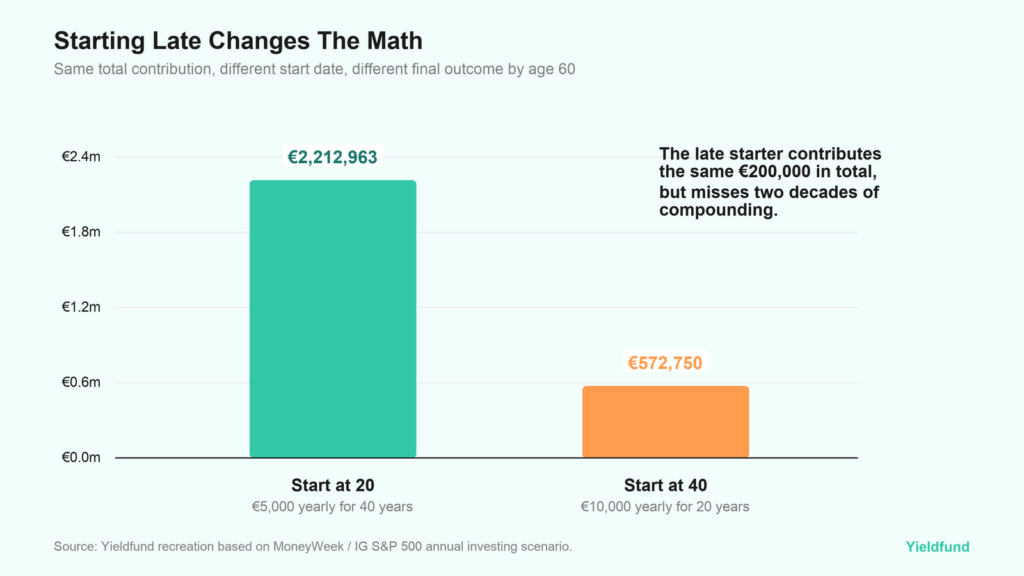
This is why many investors regret waiting: investors with at least €10,000 in assets said they wished they had started earlier, while only half said they wished they had started earlier; what’s noteworthy is that half said it took them longer to become comfortable with investing.

The last remark matters for how retail views investing, as most people don’t delay it out of laziness.

They don’t prioritize investing because it feels emotionally expensive, and they have to invest far more than just money. The gap between being financially comfortable with risk and not is high. Cash, for many, feels safe and calm, while markets create uncertainty. Over a long period of time, inflation and missed compounding can make comfort feel very expensive.

Retail investors wait for confirmation

Retail investors with minimal knowledge often look for a signal that removes doubt, and they wait until the market has recovered, an asset is trending on social media, or a friend has already made money. That behavior is understandable, but it’s why retail investors invest later, and they end up not reaping the benefits of the market.

Beginners rarely have a framework for valuation, position sizing, or risk management. They use the crowd’s wisdom to borrow confidence, and that always arrives late. The retail landscape is changing even more, with Gen Z relying on social media, online sources, and other major channels for investment information. Social access can help people start, but it also creates a feedback loop: people hear about an investment after it has already produced a story worth sharing.

This is one reason retail investors often buy after a theme becomes obvious. AI, crypto, meme stocks, commodity spikes, and high-dividend shares all follow a similar path.

Market timing feels safe, but it creates a behavior gap.

Waiting for the right moment feels like risk management. In reality, it often becomes market timing. The investor says, “I will invest after the next drop” or “I will wait until volatility calms down.” Sometimes that works. Often, it leaves the investor watching from the side as markets recover without them.

The average U.S. fund investor earned 7.0% per year over the decade through 2024, while the funds themselves earned 8.2%. That 1.2 percentage-point annual gap was linked to the timing and size of investors’ purchases and sales. This is the hidden cost of trying to be clever with timing.

Retail investors may own good products but still earn weaker results because they add after strong returns, reduce exposure after losses, or pause contributions during scary periods. The phrase “time in the market beats timing the market” is overused, but the data behind it still matters. Retail investors do not need perfect timing to build wealth; instead, they need a repeatable system that prevents them from constantly waiting for emotional certainty.

Why buying late turns into overtrading

When investing too late, traders end up overtrading, which creates more risk than not investing at all. When someone enters after a big move, their positions are more emotionally fragile, and a normal price pullback can feel like proof they made a mistake. A small gain can feel like something to protect.

Instead of holding onto plans, investors with limited knowledge react to every move. And that’s a mixture of a lack of knowledge of how markets work and emotional uncertainty about their decision.
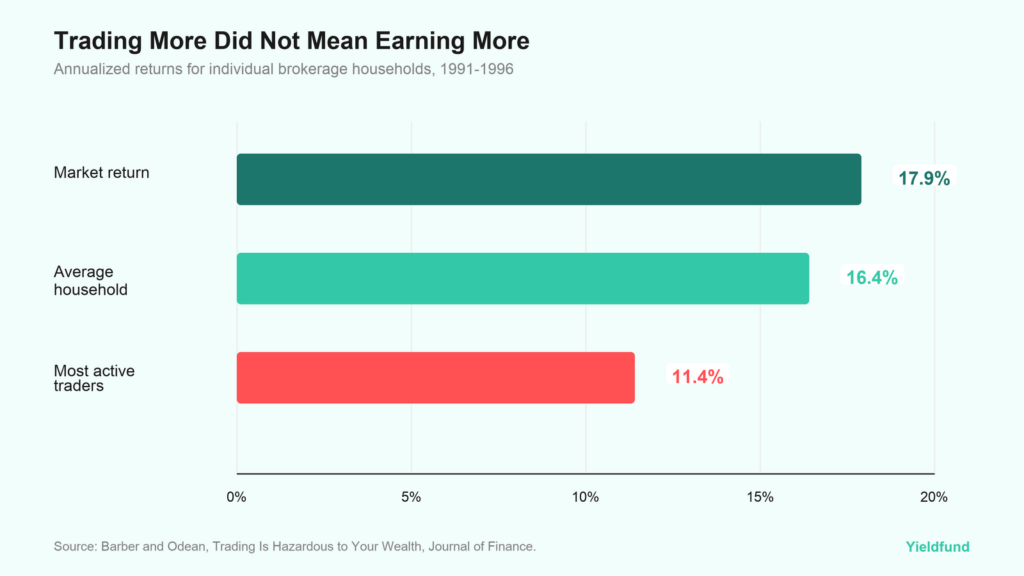
A study of 66,465 U.S. brokerage households found that the most active traders earned 11.4% annually, while the market returned 17.9% over the same period. The average household turned over 75% of its common-stock portfolio annually. Activity felt like control, but it reduced returns.

For beginner traders, it matters because a late entry and high activity reinforce each other. When an investor waits too long, buys after momentum, becomes nervous, sells quickly, then waits again. It all leads into a portfolio driven by headlines and emotions rather than a time-based horizon. It’s not that every trade is bad, but that many retail traders use trading to cope with the anxiety of not having a plan. That is an expensive substitute for strategy.

Investing early without taking risks

The answer is to replace emotional timing with rules. First, separate emergency cash from investment capital. Money needed for rent, debt payments, taxes, or short-term obligations should not be forced into volatile assets. Once that buffer is defined, the remaining capital has to be allocated to avoid losing it to inflation.

The second rule is to have a defined allocation, which means investing a fixed amount every month or a fixed percentage of income after cash needs are covered. What this does is remove the necessity for a decision that creates friction between being ready to invest and timing the market.

Third, separate core investing from speculative ideas. A beginner can keep most long-term capital in diversified exposure and reserve a smaller amount for higher-risk themes. That structure reduces the chance that FOMO becomes the entire portfolio.

Structured investing to invest early

Having cash is always useful in the moment, and waiting can be rational if the money is needed then. But waiting indefinitely because the market feels uncertain is not a strategy; it’s a decision to let fear control the entry point.

Investors are emotional, and that often leads them to invest late because they don’t want to make the wrong decisions or, worse, lose the money they worked for. What many fail to understand is that inflation is present and affects purchasing power.

Yieldfund provides a way for retail investors who are unsure of how, where, and when to invest to diversify their portfolio and earn from the performance of Yieldfund’s quant trading platform. Depending on the chosen plan, investors can earn up to 48% yearly returns and receive weekly payouts.


Related Articles

Cookies

Cookie statement for yieldfund.com

At yieldfund.com, we use cookies to improve the user experience, make our website function properly, and to display personalized content and ads. In this cookie statement, we explain what cookies we use, why we use them, and how you can manage your cookie preferences.

What are cookies?

Cookies are small text files that are stored on your device when you visit a website. These files allow the website to recognize your device during your visit and future visits. Cookies may be necessary for the website to function or may serve to personalize or improve the website.

Types of cookies we use

1. Necessary cookies
These cookies are essential for the proper functioning of the website. Without these cookies, certain parts of the website may not work properly. Necessary cookies do not collect information that can identify you.

Cookie NameProviderPersistentDurationPurpose
cf_bmhsforms.comYes0 hrSecures the website against bots and malicious traffic
_cfuvidhsforms.comNoTracks user session to optimize website performance
cf_bmhubspot.comYes0 hrWebsite protection against malicious traffic
_cfuvidhubspot.comNoSessionTracks user sessions to optimize website performance

2. Functional cookies
Functional cookies allow the website to remember user settings, such as language or login information.

Cookie NameProviderPersistentDurationPurpose
cf_bmhsforms.comYes0 hrWebsite security against bots and malicious traffic

3. Analytical cookies
Analytical cookies help us measure and improve website performance. These cookies collect anonymized data about how visitors use our website, such as the number of visitors and which pages are visited.

Cookie NameProviderPersistentDurationPurpose
hstchubspot.comYes1 yearTracks visitor behavior for website performance analysis
hssrchubspot.comNoSessionHelps determine whether the user revisits the website

4. Advertisement cookies
Advertising cookies are used to show relevant ads to you based on your browsing habits. These cookies may share information with advertising partners to show targeted ads.

Cookie NameProviderPersistentDurationPurpose
_fbpfacebook.comYes3 monthsOffers targeted ads on Facebook
_gaGoogle tag managerYes2 yearsSend data of users from devices and behavior for example to Google Analytics

How does consent work at Yieldfund?

First visit:

When you visit our website for the first time, a cookie popup will appear. Here, you can set your preferences:

  • You can accept all cookies.
  • You can selectively provide consent for specific categories of cookies (e.g., analytical or marketing cookies).

Adjusting Consent:

If you wish to modify your cookie preferences, this can be done easily:

  • At the bottom left of our website, you will find a notification button that allows you to reopen the cookie settings.
  • Through this button, you can adjust or withdraw your preferences at any time.

What are the implications of your choice?

Adjusting or refusing cookies does not affect the essential cookies required for our website to function properly. For other categories of cookies, you can easily specify what you accept or decline.
With this approach, we provide transparency and control over your cookie preferences.

For more information on how we process personal data, please refer to our Privacy Policy.

Privacy Policy

Privacy Statement of Yieldfund

Version: October 2024


Yieldfund is a trade name. The parent company of Yieldfund is Frontpay Capital B.V. For clarity, this privacy statement uses the name ‘Yieldfund,’ which also refers to Frontpay Capital B.V. This statement was originally drafted in Dutch, but versions in other languages may be available. In case of discrepancies, the Dutch version prevails.

1. Introduction

Yieldfund operates an online platform for financial services. This platform is accessible via our website: yieldfund.com and will be referred to as our “services.”

This is our Privacy Statement, explaining the types of personal data we collect and process through our services. Personal data includes all information that can directly or indirectly identify a person, as defined under the General Data Protection Regulation (GDPR). This statement also outlines our role in processing personal data, how long we retain such data, and your rights as a data subject.

We kindly ask you to read this Privacy Statement carefully. For further questions about the processing of your personal data, please contact us using the details at the end of this statement.

2. Who is responsible for processing your personal data?

Yieldfund is responsible for processing your personal data, as described in this Privacy Statement, and acts as the ‘data controller’ within the meaning of the GDPR.

For questions about processing your personal data, please contact us using the details provided at the end of this statement.

3. What personal data is processed, and where does it come from?

Yieldfund may process your personal data if you:

  • Visit or use our website or services;
  • Are a (authorized representative) client of ours;
  • Have a business relationship with Yieldfund;
  • Work at one of our service providers or other parties we collaborate with.

Special and/or sensitive personal data we process:

Our website and/or services do not intend to collect data about visitors younger than 16 years of age, unless they have parental or guardian consent. However, we cannot verify a visitor’s age. We recommend parents monitor their children’s online activities to prevent the collection of data without parental consent. If you believe we have collected personal data of a minor without consent, please contact us at info@yieldfund.com, and we will delete the information.

3.1 Information we collect automatically

When you visit our website or use our services, we automatically collect certain information, such as:

  • Usage data: including your IP address, the pages you visit, links clicked, and technical information (e.g., browser and system details). See our Cookie Statement for more details.
  • Data about your activities on our website.

3.2 Automated decision-making

Yieldfund makes decisions based on automated processes that may have significant effects on individuals.

These decisions are made by computer programs or systems without human involvement (e.g., a Yieldfund employee). Yieldfund uses the following programs or systems:

  • Sumsub: A compliance technology platform specializing in automating identity verification (IDV) and Know Your Customer (KYC) processes.

3.3 Information you provide to us

To use our services, we may request certain information, such as:

  • Registration details: Full name, address, date and place of birth, gender, phone number, country, and email address.
  • Identification details: A copy of your passport, driver’s license, or ID card, including a selfie for verification purposes.
  • Financial information: Your bank account number (if applicable), transaction details, and wallet address.
  • Other information: Source of income.

3.4 Information generated by us or received from third parties

To use our services, we may request certain information, such as:

  • Risk and fraud reports: Based on your transactions and behavior on our platform.
  • Third-party data: We may receive information from external sources such as public databases or blockchain analysis providers.

3.5 Use by third parties

Third parties include:

  • Marketing partner: HubSpot;
  • Cloud service provider: Rootnet;
  • Identity verification platform: Sumsub;
  • Communication provider: Bird.com.

Yieldfund may share data with suppliers, audit bodies, government authorities, and companies or individuals hired by Yieldfund to perform specific tasks (including processors).

Data may also be shared with third parties to support the provision of our services.

Yieldfund may provide data to third parties if required by applicable laws, court orders, or other legal obligations or with the data subject’s explicit consent.

4. For what purposes do we process your personal data?

We process your personal data for the following purposes:

  • To comply with legal obligations, such as anti-money laundering laws.
  • To deliver and improve our services.
  • To prevent fraud and abuse.
  • To communicate with you about your account and our services.
  • For marketing purposes, depending on your preferences.
  • To provide customer service.
  • For research and development to optimize our services.

5. Data retention periods

We do not retain your personal data longer than necessary for the purposes for which it was collected unless we are legally obligated to retain it longer.

Retention criteria:

  • Agreements: Data is retained for the duration of the agreement.
  • Legal obligations: Data is retained as long as legally required.
  • Legitimate interests: Data is retained as long as necessary to protect such interests.

If Yieldfund has asked for and received your (explicit) consent to process your personal data, Yieldfund will retain it until you withdraw that (explicit) consent or it is deemed to have expired without your renewed (explicit) consent.

Legal retention periods:

  • Tax purposes: 7 years after the relevant calendar year (Art. 52, Dutch General Tax Act).
  • Anti-Money Laundering and Terrorist Financing Act (Wwft): 5 years after the business relationship ends (Art. 33).
  • Wwft reporting requirements: 5 years after notification to the FIU (Art. 34).

6. Your rights

Under the GDPR, you have certain rights regarding your personal data, including the right to access, correct, delete, and restrict processing. You can exercise these rights at any time by contacting us.

7. Changes

Yieldfund reserves the right to amend this privacy statement. We recommend reviewing this statement regularly for updates.

8. Right to lodge a complaint

Yieldfund handles personal data with care and aims for continuous improvement. If you have tips or complaints about our handling of personal data, please contact Yieldfund’s Data Protection Officer. You may also file a complaint with the Dutch Data Protection Authority.

9. Security

Yieldfund has implemented appropriate technical and organizational measures to protect personal data against loss or unlawful use. If data is processed by third parties on behalf of Yieldfund, a data processing agreement ensures that data is handled securely and adequately.

International data transfer:

Personal data may be transferred outside the European Economic Area (EEA) to countries deemed to provide an adequate level of data protection under GDPR. This includes Canada (commercial organizations), Japan, Switzerland, and New Zealand. For transfers outside these countries, standard contractual clauses will apply.

10. Contact information

For questions, comments, or complaints about this Privacy Statement or the processing of your personal data, please contact us at:

  • Email: info@yieldfund.com
  • Post: Hanzeweg 5, 7418 AW, Deventer, Attn: Yieldfund Data Protection Officer