
A wide majority of retail traders lose money, with anywhere between 68% and 97% of them ending up with less than they started. In most available data, research points to the same conclusion regarding short-term, leveraged, or high-frequency trading, as it produces similar results across Europe, the UK, Australia, India, and the United States.
Aggregate losses run in the tens of billions of dollars across markets every year, which means retail traders are more often than not on the losing side.
What is the real cost of trading?
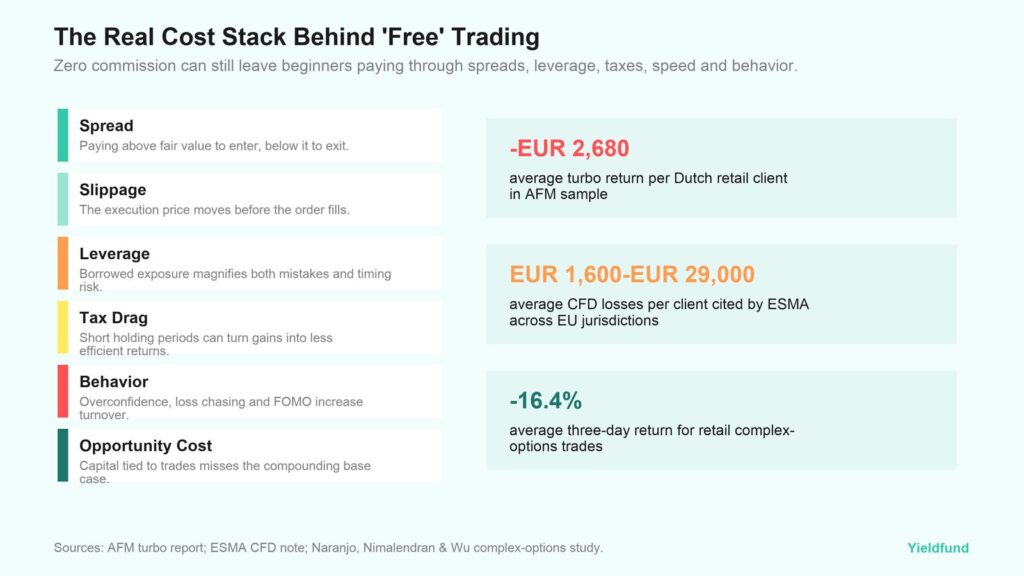
Most retail traders don't understand the underlying costs of a trade. They simply open the app, fund the account, buy and sell the stock, and repeat. But the real cost is the total expenses someone incurs during a trade. This includes spreads, slippage, or leverage.
With many platforms advertising zero-commission trading and frictionless trading, it is, in fact, the hidden costs that do the real damage. Fees are part of why traders lose, but taxes and the emotional costs of fast decisions create added stress and uncertainty.
When a strategy looks profitable on paper, inexperience leads to losses. The most useful question new traders have to ask themselves is, "How many things have to go right for this trade to beat doing nothing?" Instead, traders are asking the wrong question: "Can I place this trade?"
Data says most retail traders lose money
The strongest insights into retail trader performance come from academic studies, which show retail traders lose money. There's also a direct correlation between loss rate and leverage, complexity, and trading frequency, indicating that a lack of trading knowledge is riskier for traders.
Over a 5-year period, a study on trade performance found that 8 out of 10 day traders lost money over a 6-month trading period. What's more is that heavy day traders earned gross profits, but those profits did not cover transaction costs, and only about 1% of active traders consistently outperformed their costs.
A separate dataset focused on the futures markets shows that traders who were active for more than 300 days led to 97% of them losing money. Only 0.4% of them earned more than the equivalent of about US$54 per day.
The same evidence is seen among regulatory input. Data suggests that 68% of retail CFD clients lost money. Interestingly enough, the more someone traded, the higher their losses, with only 19% of them being profitable after fees.
In Europe and the Netherlands, derivatives trading profitability is low. In the Dutch market, research shows a parallel in the local leveraged products, as 68% of retail lost money, and more than 500 transactions led to over 88% of clients losing money.
The takeaway is that regardless of the jurisdiction and culture, retail traders aren't equipped with the knowledge to stay profitable.
Why most traders lose money
Retail traders lose money because they are exposed to significant risks. They tend to overtrade, use high leverage, and chase attention-driven stocks, putting them in direct competition with better-equipped professionals. Furthermore, most retail traders rely on manual trading, whereas highly profitable traders and institutions implement automated strategies built on a strong technical foundation.
Overall, losses are caused by a structural mismatch between the activity and the people doing the trade. Traders often compete against market makers, quant trading, or high-frequency firms. They stand out and are profitable because of faster execution, lower financing costs, and better data to drive their hypotheses.
This creates a huge gap in access and information. A retail trader sees a chart pattern and acts on it without other indicators. A market maker, on the other hand, sees order flows, volatility, and live positioning to make better decisions.
Attention drives the wrong buying
Retail buying tends to cluster on stocks that are already moving sharply, often near short-term peaks. A study done by Robinhood shows that stocks attracting the bigger retail market tend to underperform. This means that if a hyped stock is getting more volume, it tends to deliver lower returns of -4.7% over the following 20 days.
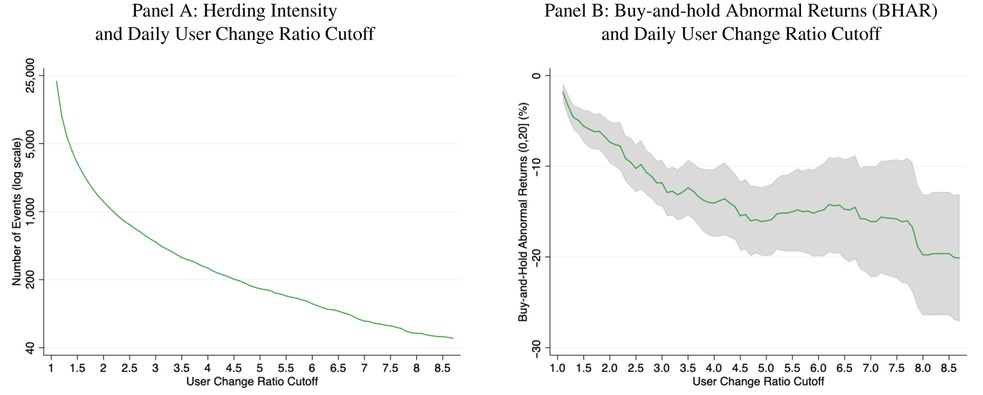
Leveraged products such as CFDs, options, and futures let investors control more exposure than their cash balance would allow. While that increases the gains a trader makes, it also magnifies the potential losses. It leads to the point that normal market moves can wipe out the value of an entire portfolio. The reason is that retail isn't aware of risk management strategies, which is why regulators who examined these products have warned against the impacts and dangers they have on traders' capital.
Overtrading Converts Uncertainty Into Repeated Costs
Each trade pays the spread, slippage, and any financing. Even when the commission is zero, data found that only 19% of retail CFD clients trading more than 50 times a month were profitable. More trades also produce more emotional decisions, which end up cutting winners early and holding onto losers. This creates a similarity to gambling—adding new positions to recover prior losses.
Complex trades fail in more ways than they succeed, as traders' average returns were −16.4% over three days, with losses worsening as complexity rose. The risk is not just direction; it's volatility, time decay, strike selection, liquidity, and pricing.
Is trading or investing better for beginners?
For beginners, investing passively produces better long-term returns compared to trading because transaction costs and timing errors compound more slowly. In day trading, they make a bigger impact on portfolios and don't leave traders with sufficient capital to continue to grow.
The causes are not always bad funds; instead, it's bad timing as investors seek to buy strong runs and sell during drawdowns. In a market study, data shows that active traders earned only 11.4% per year while the market returned 17.9%. This is a 6.5% point annual gap.
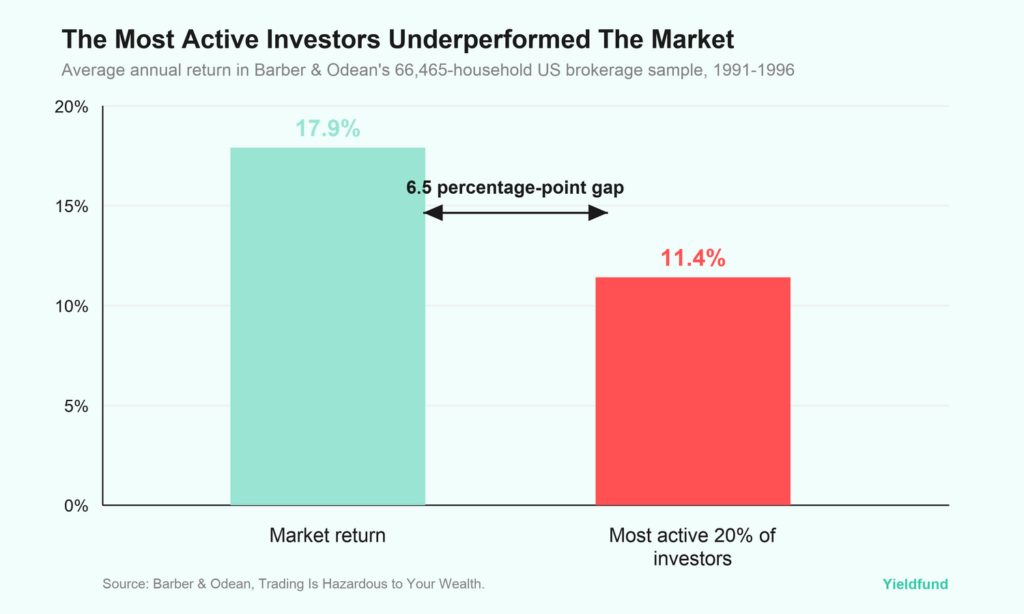
The cause was not bad funds; it was bad timing. Investors bought in after strong runs and sold during drawdowns. The more investors traded, the less they made. Now, two decades and a generation of new technology apart, the behavioral finding is unchanged: more activity, less return.
The opportunity cost is the part beginners miss most often. Money in short-term trades is money not compounding in a long-term portfolio. Even a small speculative account can become expensive if it teaches the bad habit, as it ends up measuring progress by excitement rather than by risk-adjusted return.
Strategies for retail to avoid losing money trading
The answer to avoiding losing money as a retail trader isn't to trade. Instead, beginner traders should separate investing from speculating before opening any trading app. With data backing our response, retail traders should prioritize building an investment strategy with a time horizon and diversified exposure.
Only after that should they consider speculative trading, but it should be limited in size and not the foundation of the growth plan. In our experience, building wealth while taking unnecessary risks isn't possible.
New investors should also measure every trade after all costs. That means not only commission but spread, slippage, financing, taxes, and the time spent managing the position. If a strategy only looks good before costs, it is not a strategy.
The second rule is to avoid leverage until the investor can explain how the product affects portfolios in a bad market. If a position can lose most of its value because of one sharp move, one volatility shift, or one expiry date, it belongs in the high-risk bucket.
The third rule is to compare trading results with a passive alternative. If a trading account produces more stress, more turnover, and worse results than a simple diversified portfolio, the data has already given its answer.
The real cost of trading is not just money lost on individual trades. It is the possibility that a beginner mistakes activity for progress. The market rewards patience more often than it rewards urgency. At Yieldfund, we believe understanding and knowing the risks are more important for investors than actually trading. We built the company to make access to crypto yields possible without having traders do the trading themselves. We provide yearly returns of up to 48% with weekly payouts for retail and experienced investors.