

The economic aftermath and impact of the US/Iran conflict in 6 Months

7 min

The US/Iran conflict is far from over, yet it has managed to create economic distress. As global supply lines and oil stocks get depleted, in 6 months the global economy could be a lot worse than we imagine it to be. Even as oil headlines would have cooled, shipping through the Strait of Hormuz would be partially restored and central banks would be discussing recovery rather than conflict.

The aftermath of the conflict can look different depending on how the conflict will evolve and whether new escalations will occur. Damages inflicted by the shock operate on delays, with some channels requiring months to years. The global economic situation at the end of the year will be shaped by past disruptions that are still affecting the system.

You can already see the shape of that aftermath in current forecasts. Energy prices will be lower but not normalized. Food inflation will be accelerating just as energy inflation subsides. Refining and shipping costs will have established a structurally higher baseline. And the European economy, with the Netherlands serving as a clear example, will carry a thinner growth cushion into 2027 than it had entering 2026.

From headlines to economic reality

In 6 months, the conflict will have transitioned from price outlooks into the balance sheets of households and governments. IMF outlooks project global growth at 3.1% in 2026, while in Europe projections are set at 1.1%, if the conflict doesn’t escalate. This means brent oil prices remain the same and the shock remains contained. The current projects are already revised down from late-2025 expectations.
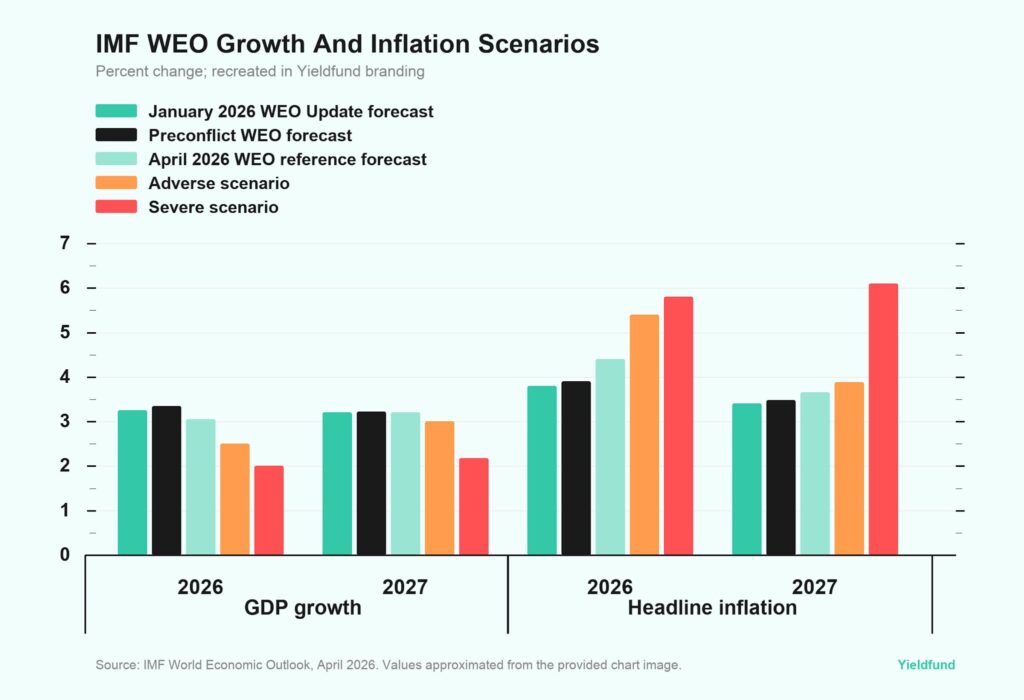
In 6 months, capital expenditure plans paused in Q2 and Q3 will not have fully resumed. This in turn will mean business confidence will be below pre-conflict levels while saving rates will continue to drop as consumers will have to manage higher utility and grocery bills. In Q4 of 2025, household savings had already decreased by 0.4% in the EU due to other macroeconomic events.

While not dramatic, this creates a persistent, cumulative drag that pushes recovery into 2027 rather than the second half of 2026 that consensus had anticipated last year.

Energy markets remain a core problem

The more important metric that will create issues is the energy market. The underlying structural costs would not have normalized by the end of 2026. Brent prices will not ease as aggressively as they spiked. The EIA underlines that prices could ease from $106 in June to approximately $79 in 2027, if the conflict isn’t escalating or continuing and oil production can recover.

A report by Goldman Sachs reinforced the price prediction, as countries will look to rebuild their strategic oil reserves. The forecasts for 2026 are dependent entirely on a few moving factors which could persist even after crude prices soften.

Europe’s refining capacity and inventories. Europe’s ARA hub will have operated through 2026 well below normal levels for two reasons. Refiners depleted stocks to compensate for lost Gulf crude, and several European refiners that were already on the edge of closure used the high-margin period to harvest profits rather than reinvest.

S&P Global identified before the conflict that European refining is experiencing a long-running attrition cycle due to high compliance costs. These increased from $0.60–0.80 per barrel today to $3–4 per barrel by 2035 and the Gulf conflict only accelerates this trend. By November, Europe enters heating season with thinner diesel and gasoil buffers than at any point since 2022.

War-risk insurance. Pre-conflict Hormuz transit insurance operated around 0.25% of vessel value. New quotes will not shrink and remain elevated at $3-8 million per large tanker. The base case suggests that premiums will have eased by only 1-2% as insurance companies need stability before fully repricing. This will still mean they will be four to eight times higher than pre-conflict levels. This cost transfers directly into refined-product prices and freight rates.

OPEC+ cohesion. The conflict accelerated a fracture that was already developing. Wood Mackenzie has identified the UAE’s movement away from the formal OPEC+ structure during the crisis, weakening the ability to defend prices when demand softens. This signals bearish implications for oil in 2027 but bullish for volatility as future shocks will reprice faster and overshoot more significantly.

Inflation is becoming the bigger risk

The most important shift between now and the end of 2026 will be the transition from energy inflation to food inflation. Energy inflation is projected to peak in Q2 and decrease in Q3 due to “base effects.” The ECB models energy inflation could turn negative in 2027 while food will only start its cycle.

The delay in inflation points is mechanical as fertilizer prices are expected to increase by 30% in 2026. The closure of the Strait of Hormuz disrupted more than just oil. It also created a shortage in nitrogen and phosphate fertilizer trade.
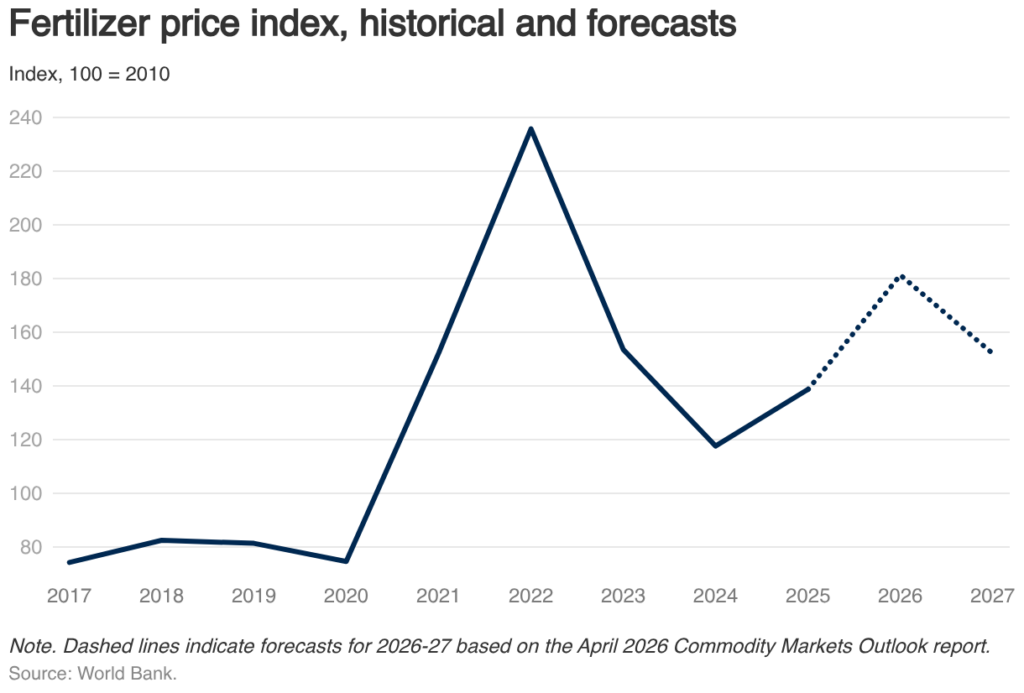
The spring 2026 planting season used more expensive fertilizer, sometimes less of it, and in some emerging markets, simply less land was planted. These decisions manifest in 2026/27 crop yields and in food prices on a six-to-twelve-month delay.

In Europe, data from RaboResearch emphasize that food price inflation is expected to increase throughout 2026 and intensify in 2027. Data suggests food inflation in the Euro zone at 5-10% in 2027, while in other countries it can increase further. The mechanism is that European food retailers set prices annually, so most of the 2026 input-cost shock will be locked in during late-2026 contract negotiations and become visible on shelves in 2027.

This timing matters for the end of the year because central banks will be making rate decisions while energy inflation fades but food inflation begins to accelerate. ECB projects already show revised HICP up to 2.3% in 2026 and 2.2% in 2027 due to higher energy costs that feed into food and services which currently lag.

The risk in November is not runaway wages but sticky core inflation that prevents the ECB from cutting as quickly as both growth and energy data alone would justify. The most likely scenario shows euro area headline inflation returning toward 2.5%, but core stuck near 2.3% and food inflation accelerating into a 2027 peak.

Europe faces a direct squeeze

The aftermath in Europe can be more severe because the region absorbs the energy shock, the food shock, and delayed monetary easing simultaneously, on top of a weak growth starting point.

The Dutch GDP is projected at 1.3% in 2026, with elevated services inflation through 2025–26, and recovery only in 2027. This forecast was made before the full conflict shock was incorporated and the DNB scenarios show Dutch growth approximately 0.5% lower and inflation around 1 percentage point higher in the adverse case for both 2026 and 2027.
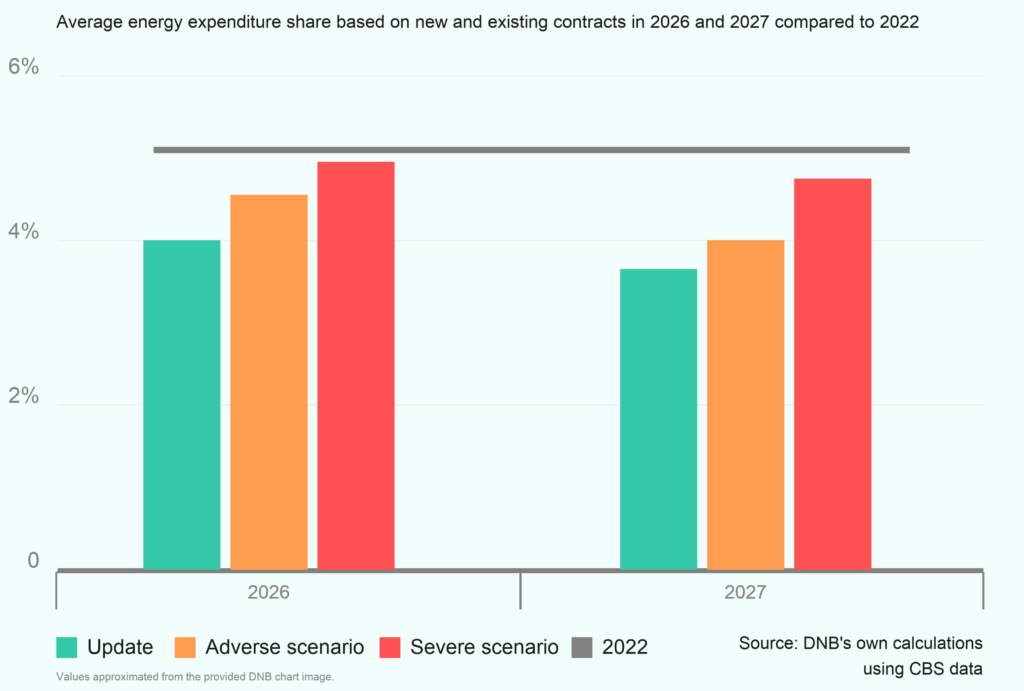
This means that disposable income will be affected by roughly 1% from higher energy costs in DNB’s limited scenario, scaling to 6% in the severe case. Export-exposed Dutch sectors such as logistics, refining, chemicals, food processing, and machinery, will be reporting weaker order books for early 2027.

The corporate refinancing wall, which the eurozone had been managing relatively smoothly, will face materially tighter conditions because the ECB has not cut as much as expected and credit spreads have widened due to growth concerns.

For many Dutch residents, real incomes are still recovering from 2022, mortgage costs are not yet meaningfully lower, and a new round of food-price increases are just starting. While none of these individually reaches crisis levels, together they push consumer confidence and consumption deeper into precautionary mode.

The forward conclusion

The aftermath of the US/Iran conflict in November 2026 does not mark the moment the shock ends. It represents the moment when the second wave will affect global economies.

While energy inflation has passed its peak, costs for refined products, freight, and insurance are still structurally elevated. The fertilizer shock from spring 2026 is now impacting crop yields and raising food prices, with European food inflation projected to be 5–10% in 2027. Although wages have not spiraled, core inflation remains too sticky for the ECB to cut rates as quickly as the weak growth outlook would otherwise warrant.

Here’s how to understand the next six months: the global economy will appear to have absorbed the shock, but it will be absorbing it for longer than forecasts written in late 2025 assumed and Europe ends 2026 with weaker than projected growth.


Related Articles

Cookies

Cookie statement for yieldfund.com

At yieldfund.com, we use cookies to improve the user experience, make our website function properly, and to display personalized content and ads. In this cookie statement, we explain what cookies we use, why we use them, and how you can manage your cookie preferences.

What are cookies?

Cookies are small text files that are stored on your device when you visit a website. These files allow the website to recognize your device during your visit and future visits. Cookies may be necessary for the website to function or may serve to personalize or improve the website.

Types of cookies we use

1. Necessary cookies
These cookies are essential for the proper functioning of the website. Without these cookies, certain parts of the website may not work properly. Necessary cookies do not collect information that can identify you.

Cookie NameProviderPersistentDurationPurpose
cf_bmhsforms.comYes0 hrSecures the website against bots and malicious traffic
_cfuvidhsforms.comNoTracks user session to optimize website performance
cf_bmhubspot.comYes0 hrWebsite protection against malicious traffic
_cfuvidhubspot.comNoSessionTracks user sessions to optimize website performance

2. Functional cookies
Functional cookies allow the website to remember user settings, such as language or login information.

Cookie NameProviderPersistentDurationPurpose
cf_bmhsforms.comYes0 hrWebsite security against bots and malicious traffic

3. Analytical cookies
Analytical cookies help us measure and improve website performance. These cookies collect anonymized data about how visitors use our website, such as the number of visitors and which pages are visited.

Cookie NameProviderPersistentDurationPurpose
hstchubspot.comYes1 yearTracks visitor behavior for website performance analysis
hssrchubspot.comNoSessionHelps determine whether the user revisits the website

4. Advertisement cookies
Advertising cookies are used to show relevant ads to you based on your browsing habits. These cookies may share information with advertising partners to show targeted ads.

Cookie NameProviderPersistentDurationPurpose
_fbpfacebook.comYes3 monthsOffers targeted ads on Facebook
_gaGoogle tag managerYes2 yearsSend data of users from devices and behavior for example to Google Analytics

How does consent work at Yieldfund?

First visit:

When you visit our website for the first time, a cookie popup will appear. Here, you can set your preferences:

  • You can accept all cookies.
  • You can selectively provide consent for specific categories of cookies (e.g., analytical or marketing cookies).

Adjusting Consent:

If you wish to modify your cookie preferences, this can be done easily:

  • At the bottom left of our website, you will find a notification button that allows you to reopen the cookie settings.
  • Through this button, you can adjust or withdraw your preferences at any time.

What are the implications of your choice?

Adjusting or refusing cookies does not affect the essential cookies required for our website to function properly. For other categories of cookies, you can easily specify what you accept or decline.
With this approach, we provide transparency and control over your cookie preferences.

For more information on how we process personal data, please refer to our Privacy Policy.

Privacy Policy

Privacy Statement of Yieldfund

Version: October 2024


Yieldfund is a trade name. The parent company of Yieldfund is Frontpay Capital B.V. For clarity, this privacy statement uses the name ‘Yieldfund,’ which also refers to Frontpay Capital B.V. This statement was originally drafted in Dutch, but versions in other languages may be available. In case of discrepancies, the Dutch version prevails.

1. Introduction

Yieldfund operates an online platform for financial services. This platform is accessible via our website: yieldfund.com and will be referred to as our “services.”

This is our Privacy Statement, explaining the types of personal data we collect and process through our services. Personal data includes all information that can directly or indirectly identify a person, as defined under the General Data Protection Regulation (GDPR). This statement also outlines our role in processing personal data, how long we retain such data, and your rights as a data subject.

We kindly ask you to read this Privacy Statement carefully. For further questions about the processing of your personal data, please contact us using the details at the end of this statement.

2. Who is responsible for processing your personal data?

Yieldfund is responsible for processing your personal data, as described in this Privacy Statement, and acts as the ‘data controller’ within the meaning of the GDPR.

For questions about processing your personal data, please contact us using the details provided at the end of this statement.

3. What personal data is processed, and where does it come from?

Yieldfund may process your personal data if you:

  • Visit or use our website or services;
  • Are a (authorized representative) client of ours;
  • Have a business relationship with Yieldfund;
  • Work at one of our service providers or other parties we collaborate with.

Special and/or sensitive personal data we process:

Our website and/or services do not intend to collect data about visitors younger than 16 years of age, unless they have parental or guardian consent. However, we cannot verify a visitor’s age. We recommend parents monitor their children’s online activities to prevent the collection of data without parental consent. If you believe we have collected personal data of a minor without consent, please contact us at info@yieldfund.com, and we will delete the information.

3.1 Information we collect automatically

When you visit our website or use our services, we automatically collect certain information, such as:

  • Usage data: including your IP address, the pages you visit, links clicked, and technical information (e.g., browser and system details). See our Cookie Statement for more details.
  • Data about your activities on our website.

3.2 Automated decision-making

Yieldfund makes decisions based on automated processes that may have significant effects on individuals.

These decisions are made by computer programs or systems without human involvement (e.g., a Yieldfund employee). Yieldfund uses the following programs or systems:

  • Sumsub: A compliance technology platform specializing in automating identity verification (IDV) and Know Your Customer (KYC) processes.

3.3 Information you provide to us

To use our services, we may request certain information, such as:

  • Registration details: Full name, address, date and place of birth, gender, phone number, country, and email address.
  • Identification details: A copy of your passport, driver’s license, or ID card, including a selfie for verification purposes.
  • Financial information: Your bank account number (if applicable), transaction details, and wallet address.
  • Other information: Source of income.

3.4 Information generated by us or received from third parties

To use our services, we may request certain information, such as:

  • Risk and fraud reports: Based on your transactions and behavior on our platform.
  • Third-party data: We may receive information from external sources such as public databases or blockchain analysis providers.

3.5 Use by third parties

Third parties include:

  • Marketing partner: HubSpot;
  • Cloud service provider: Rootnet;
  • Identity verification platform: Sumsub;
  • Communication provider: Bird.com.

Yieldfund may share data with suppliers, audit bodies, government authorities, and companies or individuals hired by Yieldfund to perform specific tasks (including processors).

Data may also be shared with third parties to support the provision of our services.

Yieldfund may provide data to third parties if required by applicable laws, court orders, or other legal obligations or with the data subject’s explicit consent.

4. For what purposes do we process your personal data?

We process your personal data for the following purposes:

  • To comply with legal obligations, such as anti-money laundering laws.
  • To deliver and improve our services.
  • To prevent fraud and abuse.
  • To communicate with you about your account and our services.
  • For marketing purposes, depending on your preferences.
  • To provide customer service.
  • For research and development to optimize our services.

5. Data retention periods

We do not retain your personal data longer than necessary for the purposes for which it was collected unless we are legally obligated to retain it longer.

Retention criteria:

  • Agreements: Data is retained for the duration of the agreement.
  • Legal obligations: Data is retained as long as legally required.
  • Legitimate interests: Data is retained as long as necessary to protect such interests.

If Yieldfund has asked for and received your (explicit) consent to process your personal data, Yieldfund will retain it until you withdraw that (explicit) consent or it is deemed to have expired without your renewed (explicit) consent.

Legal retention periods:

  • Tax purposes: 7 years after the relevant calendar year (Art. 52, Dutch General Tax Act).
  • Anti-Money Laundering and Terrorist Financing Act (Wwft): 5 years after the business relationship ends (Art. 33).
  • Wwft reporting requirements: 5 years after notification to the FIU (Art. 34).

6. Your rights

Under the GDPR, you have certain rights regarding your personal data, including the right to access, correct, delete, and restrict processing. You can exercise these rights at any time by contacting us.

7. Changes

Yieldfund reserves the right to amend this privacy statement. We recommend reviewing this statement regularly for updates.

8. Right to lodge a complaint

Yieldfund handles personal data with care and aims for continuous improvement. If you have tips or complaints about our handling of personal data, please contact Yieldfund’s Data Protection Officer. You may also file a complaint with the Dutch Data Protection Authority.

9. Security

Yieldfund has implemented appropriate technical and organizational measures to protect personal data against loss or unlawful use. If data is processed by third parties on behalf of Yieldfund, a data processing agreement ensures that data is handled securely and adequately.

International data transfer:

Personal data may be transferred outside the European Economic Area (EEA) to countries deemed to provide an adequate level of data protection under GDPR. This includes Canada (commercial organizations), Japan, Switzerland, and New Zealand. For transfers outside these countries, standard contractual clauses will apply.

10. Contact information

For questions, comments, or complaints about this Privacy Statement or the processing of your personal data, please contact us at:

  • Email: info@yieldfund.com
  • Post: Hanzeweg 5, 7418 AW, Deventer, Attn: Yieldfund Data Protection Officer